
The Anointing of David
When the prophet Samuel arrives in Bethlehem to anoint the next king, God's choice surprises everyone. Discover the moment when divine destiny meets human humility.
The Anointing of David
The arrival of the prophet Samuel in Bethlehem marked a turning point not only in David's life but in the entire history of Israel. Sent by God to anoint a new king, Samuel's mission was shrouded in secrecy and fraught with danger. King Saul still sat on the throne, and any hint of choosing his successor could be interpreted as treason.
God's Rejection of Saul
To understand the significance of David's anointing, we must first understand why God rejected Saul. Israel's first king had started well, but his reign was marked by a pattern of disobedience and presumption:
- He offered an unauthorized sacrifice, usurping the role of the priest (1 Samuel 13)
- He made a foolish oath that endangered his own son Jonathan (1 Samuel 14)
- He partially obeyed God's command to destroy the Amalekites, keeping the best plunder for himself (1 Samuel 15)
After this final act of disobedience, God spoke to Samuel with devastating clarity:
"I regret that I have made Saul king, because he has turned away from me and has not carried out my instructions." (1 Samuel 15:11)
Samuel grieved over Saul, but God's decision was final. The kingdom would be torn from Saul and given to "a man after his own heart" (1 Samuel 13:14). Now God was sending Samuel to find and anoint that man.
The Secret Mission
God's instructions to Samuel were specific: "Fill your horn with oil and be on your way; I am sending you to Jesse of Bethlehem. I have chosen one of his sons to be king" (1 Samuel 16:1).
But Samuel was afraid. "How can I go?" he asked. "If Saul hears about it, he will kill me" (1 Samuel 16:2). God provided a cover story—Samuel would go to Bethlehem to offer a sacrifice, and during that visit, he would anoint the chosen son of Jesse.
This clandestine nature of David's anointing is significant. Unlike Saul, who was publicly proclaimed king before all Israel, David's anointing was a private affair, witnessed only by his family. His path to the throne would not be immediate or easy—it would require years of waiting, testing, and trusting in God's timing.
The Parade of Sons
When Samuel arrived in Bethlehem, the elders of the town trembled. A visit from the prophet was rarely good news. But Samuel reassured them and invited Jesse and his sons to the sacrifice.
As Jesse's sons passed before Samuel, the prophet's human reasoning kicked in. When he saw Eliab, Jesse's firstborn, he thought, "Surely the LORD's anointed stands here before the LORD" (1 Samuel 16:6).
Eliab must have been impressive—tall, strong, handsome, every inch a king. But God's response to Samuel was immediate and instructive:
"Do not consider his appearance or his height, for I have rejected him. The LORD does not look at the things people look at. People look at the outward appearance, but the LORD looks at the heart." (1 Samuel 16:7)
This statement reveals a fundamental principle of God's kingdom: He values character over charisma, heart over height, faithfulness over physical impressiveness. It's a principle that runs throughout Scripture and stands in stark contrast to worldly values.
One by one, seven of Jesse's sons passed before Samuel. Each time, God said no. Finally, a confused Samuel asked Jesse, "Are these all the sons you have?"
"There is still the youngest," Jesse replied, "but he is tending the sheep" (1 Samuel 16:11).
The fact that David wasn't even invited to the sacrifice speaks volumes about his status in the family. He was the youngest, the least regarded, the one left to do the menial work while his brothers attended the important religious ceremony.
But Samuel insisted: "Send for him; we will not sit down until he arrives."
The Chosen One
When David arrived from the fields, the biblical description is brief but telling: "He was glowing with health and had a fine appearance and handsome features" (1 Samuel 16:12).
David was not unattractive—the text makes that clear. But his physical appearance was not the reason for his selection. God had already told Samuel that He looks at the heart, not the outward appearance.
What did God see in David's heart that He didn't see in his brothers? What qualities had been developed during those years in the wilderness that made him suitable to be king?
A Heart for God
Above all else, David had a heart that sought after God. His psalms reveal a man who longed for God's presence, who delighted in God's word, who worshiped with abandon. This passion for God was the defining characteristic of David's life.
Humility
David had no sense of entitlement. He didn't demand recognition or position. He was content to serve in obscurity, doing the work assigned to him without complaint.
Faithfulness
David had proven himself faithful in small things—caring for his father's sheep, facing predators, doing his work with excellence. This faithfulness in the hidden place qualified him for greater responsibility.
Courage
David's encounters with lions and bears had developed in him a courage rooted not in his own strength but in his confidence in God's deliverance.
A Teachable Spirit
Throughout his life, David demonstrated a willingness to learn, to receive correction, to acknowledge his mistakes. This teachability would prove crucial in the years ahead.
The Anointing
Then the LORD said, "Rise and anoint him; this is the one" (1 Samuel 16:12).
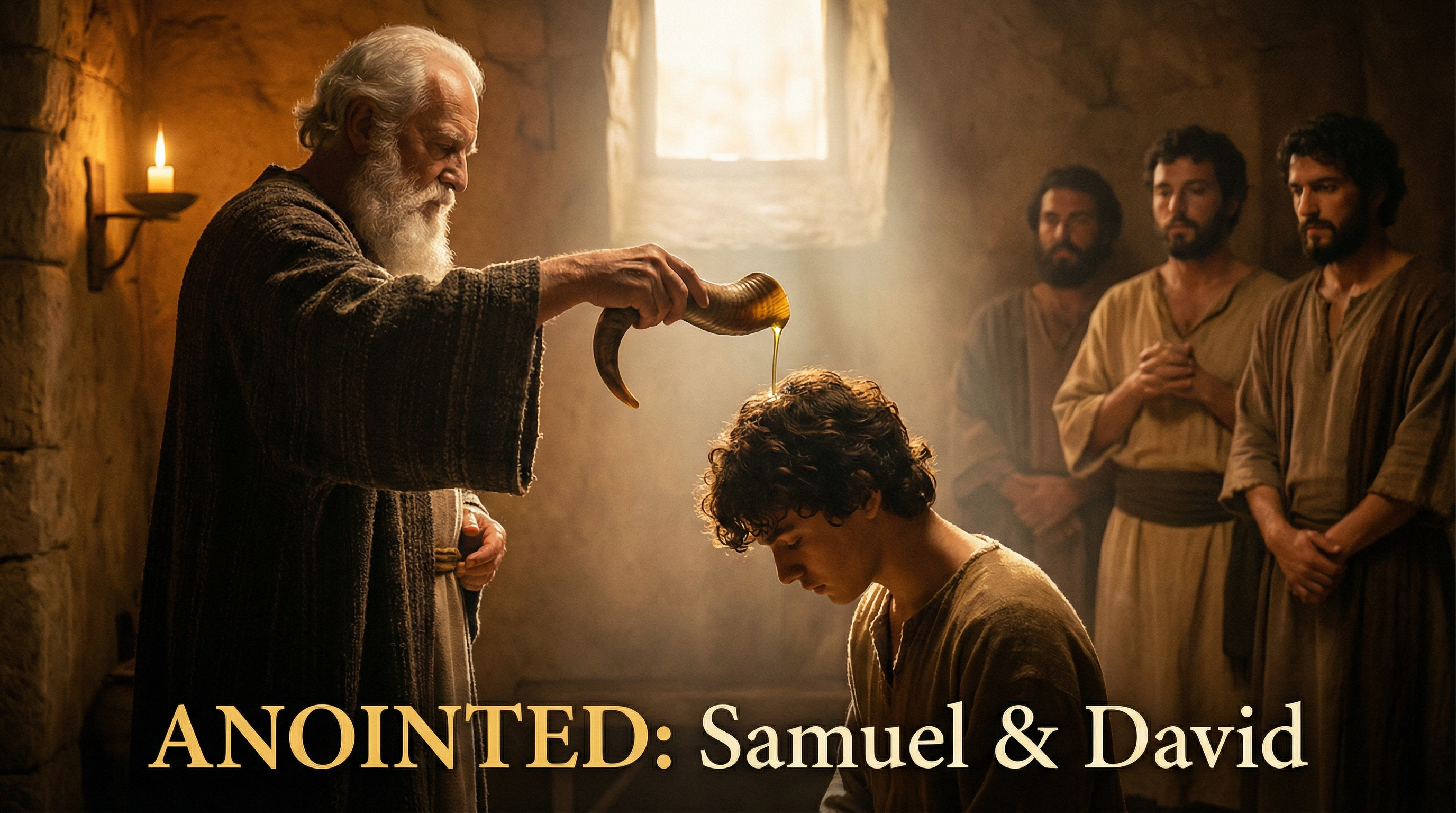
Samuel took the horn of oil and anointed David in the presence of his brothers. The oil, poured over his head, symbolized the Holy Spirit's empowerment for the task ahead. The text tells us that "from that day on the Spirit of the LORD came powerfully upon David" (1 Samuel 16:13).
This anointing was both a commissioning and an empowering. It set David apart for God's purposes and equipped him with divine enablement to fulfill his calling. Yet it's crucial to note that the anointing did not immediately make David king. That would come years later, after much testing and preparation.
The Contrast with Saul
The very next verse provides a stark and sobering contrast: "Now the Spirit of the LORD had departed from Saul, and an evil spirit from the LORD tormented him" (1 Samuel 16:14).
As the Spirit came upon David, He departed from Saul. As David's star was rising, Saul's was setting. This transition period—with two anointed individuals, one chosen by God and one rejected—would create years of tension and conflict.
Saul's descent into madness and David's rise to prominence would unfold simultaneously, their paths intertwining in ways that would test David's character and faith to the utmost.
The Hidden King
After his anointing, David returned to the sheep. There was no public proclamation, no coronation ceremony, no immediate change in his circumstances. He was anointed king, but he was still a shepherd.
This gap between calling and fulfillment is a common biblical pattern. Joseph dreamed of rulership but spent years as a slave and prisoner. Moses was called at the burning bush but spent forty years in the wilderness before leading the Exodus. Paul was converted on the Damascus road but spent years in obscurity before beginning his missionary journeys.
God often anoints us long before He appoints us. He calls us to a destiny but then leads us through a process of preparation. The anointing is God's declaration of what we will become; the journey is His development of what we must be.
For David, the years between anointing and coronation would be filled with triumph and tragedy, victory and exile, faith and fear. But through it all, the anointing remained—God's promise that His purposes would ultimately prevail.
Lessons for Today
David's anointing offers profound lessons for believers today:
-
God Looks at the Heart: Our value to God is not determined by our appearance, abilities, or achievements, but by the condition of our heart toward Him.
-
God's Choices Surprise Us: God often chooses the unlikely, the overlooked, the least regarded. His ways are not our ways.
-
Anointing Precedes Appointment: God may call you to something long before you step into it. Use the waiting period to develop character and deepen your relationship with Him.
-
The Spirit's Empowerment: The same Spirit that came upon David is available to believers today. We need divine empowerment to fulfill our calling.
-
Humility Qualifies: David's humility, demonstrated in his willingness to serve in obscurity, qualified him for leadership. Pride disqualifies; humility qualifies.
-
Faithfulness in the Hidden Place: God was watching David in the fields when no one else was. He sees your faithfulness in the hidden places.
Conclusion
The anointing of David was a pivotal moment in biblical history. It marked the beginning of a dynasty that would culminate in the coming of Jesus Christ, the ultimate "Son of David." But it also provides a template for understanding how God calls and prepares His servants.
David's anointing reminds us that God is not impressed by what impresses humans. He looks past the external to the internal, past the appearance to the heart. He chooses not based on human credentials but on spiritual readiness.
The shepherd boy anointed in secret would one day be the king acclaimed in public. But first, he had to walk the path from anointing to appointment, from calling to fulfillment. That journey would test everything in him, revealing both his strengths and his weaknesses, his faith and his failures.
Yet through it all, one thing remained constant: the anointing. God's choice. God's call. God's promise that what He had begun, He would complete.
In our next study, we will explore David's famous encounter with Goliath—the moment when the shepherd boy's faith was tested before the entire nation.