
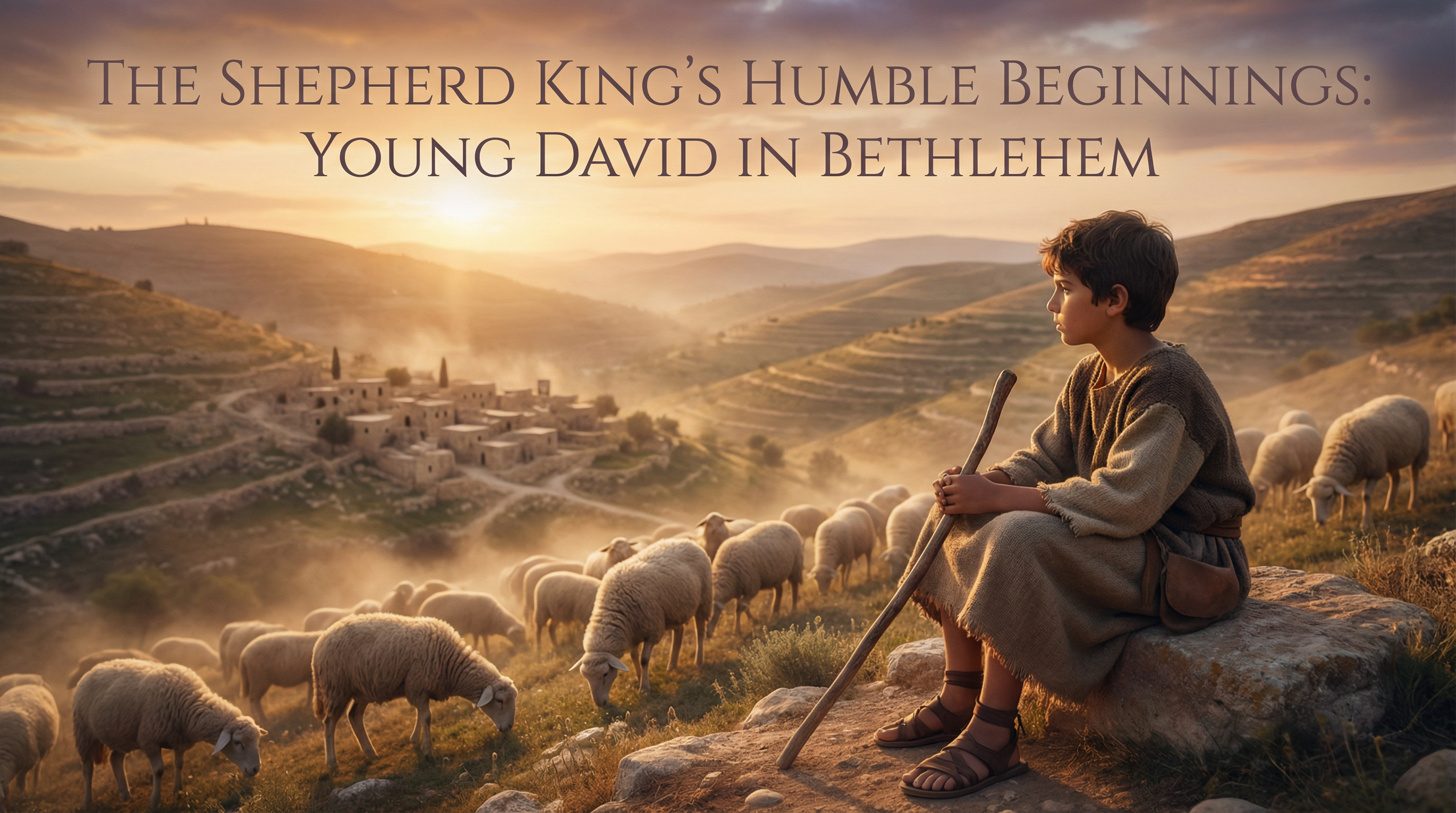
The Shepherd Boy of Bethlehem
Explore the humble beginnings of Israel's greatest king. From the fields of Bethlehem to the throne of a nation, David's journey begins with faithfulness in the small things.
The Shepherd Boy of Bethlehem
David's story begins not in a palace, but in the fields of Bethlehem. Born as the youngest of eight sons to Jesse, David spent his formative years tending his father's sheep in the hills surrounding his hometown. This seemingly insignificant role would prove to be the perfect preparation for his future calling as the shepherd-king of Israel.
The Youngest Son
In ancient Israelite culture, the youngest son occupied the lowest position in the family hierarchy. While his older brothers were considered for positions of honor and responsibility, David was relegated to the fields, watching over the family's flock. Yet it was precisely in this place of obscurity that God was preparing David for greatness.
"The LORD does not look at the things people look at. People look at the outward appearance, but the LORD looks at the heart." (1 Samuel 16:7)
David's position as the youngest and least regarded son teaches us a profound spiritual truth: God's ways are not our ways. While human society values position, power, and prestige, God looks for faithfulness, humility, and a heart that seeks after Him.
The School of the Wilderness
The wilderness became David's classroom, and the sheep his first congregation. In those lonely hills, David learned lessons that would serve him throughout his life:
Faithfulness in Small Things
Tending sheep was monotonous, unglamorous work. Day after day, David led the flock to pasture, protected them from predators, and ensured their wellbeing. This daily faithfulness in small responsibilities was preparing him to shepherd an entire nation.
Jesus would later teach this same principle: "Whoever can be trusted with very little can also be trusted with much" (Luke 16:10). David's faithfulness with his father's sheep demonstrated his readiness to care for God's people.
Courage in the Face of Danger
The wilderness was not a safe place. Lions and bears prowled the hills, seeking to devour the vulnerable sheep. David's own testimony reveals that he faced these predators multiple times, killing both a lion and a bear to protect his flock (1 Samuel 17:34-36).
These encounters developed in David a courage that would later enable him to face Goliath. More importantly, they taught him to trust in God's deliverance. Each victory over a wild beast strengthened his faith that the same God who delivered him from the paw of the lion and the bear would deliver him from any enemy.
Intimacy with God
Perhaps most significantly, the solitude of the shepherd's life provided David with uninterrupted time to develop his relationship with God. It was likely during these years that David composed many of the psalms that would later become the songbook of Israel.
Psalm 23, the most beloved of all psalms, reflects David's shepherd experience:
"The LORD is my shepherd, I lack nothing. He makes me lie down in green pastures, he leads me beside quiet waters, he refreshes my soul."
David's understanding of God as shepherd was not theoretical—it was born from his own experience as a shepherd. He knew what sheep needed because he had provided it. He understood God's care because he had demonstrated that same care to his flock.
The Development of Character
The wilderness years shaped David's character in ways that palace life never could have. Away from the corrupting influence of power and prestige, David developed the qualities that would make him "a man after God's own heart":
Humility
David never forgot his humble origins. Even after becoming king, he remembered that he was once a shepherd boy. This humility would enable him to receive correction, acknowledge his sins, and maintain a teachable spirit throughout his life.
Dependence on God
In the wilderness, David had no one to rely on but God. This forced dependence became the foundation of his spiritual life. He learned to pray, to worship, to seek God's guidance in every situation.
Compassion
A good shepherd develops a tender heart toward his sheep. David's years of caring for vulnerable animals cultivated in him a compassion that would later characterize his leadership. He would become known as a king who cared for the weak and defended the oppressed.
Skill and Excellence
David didn't just go through the motions of shepherding—he excelled at it. He became skilled with the sling, able to hit a target with deadly accuracy. He learned to play the harp with such mastery that his music could soothe a troubled soul. These skills, developed in obscurity, would later open doors of opportunity.
The Hidden Years
We know little about the specific events of David's early years. The biblical narrative passes over them quickly, moving from his birth to his anointing. Yet these "hidden years" were not wasted time. They were years of preparation, of character formation, of spiritual development.
This pattern appears throughout Scripture. Moses spent forty years in the wilderness before leading the Exodus. Jesus spent thirty years in Nazareth before beginning His public ministry. Paul spent years in Arabia after his conversion before beginning his missionary journeys.
God often does His deepest work in us during seasons of obscurity. When no one is watching, when there is no applause, when we are simply faithful in the place He has put us—that is when He is shaping us for our destiny.
Lessons for Today
David's early years as a shepherd boy offer timeless lessons for believers today:
-
Faithfulness in Small Things: God is preparing us in our current responsibilities for future opportunities. Be faithful where you are.
-
Embrace Obscurity: Seasons of hiddenness are not setbacks—they are setups for what God wants to do in and through us.
-
Develop Your Relationship with God: Use quiet seasons to deepen your intimacy with the Lord. The strength of your public ministry will never exceed the depth of your private devotion.
-
Face Your Lions and Bears: Don't run from the challenges in your current season. Each victory builds faith for future battles.
-
Excellence Matters: Do your current work with excellence, even if no one notices. God sees, and He is preparing you for greater things.
Conclusion
The shepherd boy of Bethlehem seemed an unlikely candidate for kingship. Yet in God's economy, the last shall be first, and the humble shall be exalted. David's years in the wilderness were not a detour from his destiny—they were the pathway to it.
As we follow David's journey from the sheepfolds of Bethlehem to the throne of Israel, we see a consistent pattern: God uses the humble, the faithful, and the obscure to accomplish His purposes. He takes shepherd boys and makes them kings.
The question for us is not whether we have a significant position or impressive credentials. The question is whether we are faithful where God has placed us, whether we are developing our relationship with Him, and whether we are allowing Him to shape our character in the hidden places.
David's story reminds us that no season is wasted in God's hands. Every experience, every challenge, every moment of obscurity is part of His preparation for the calling He has placed on our lives.
In our next study, we will explore the pivotal moment when the prophet Samuel arrives in Bethlehem to anoint the next king of Israel—and how God's choice surprises everyone.