
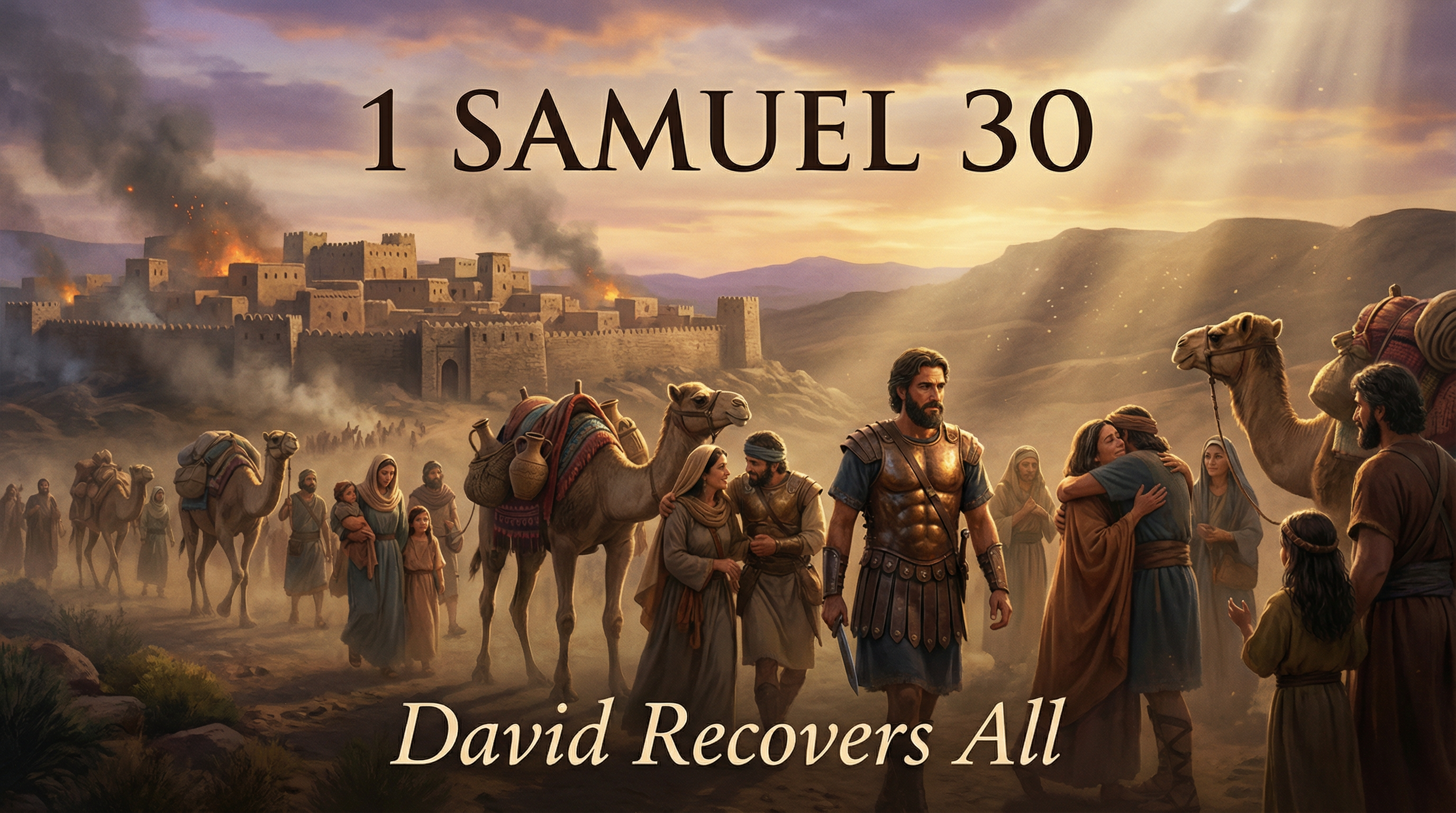
David Recovers All: Faith and Leadership in Crisis
When David returned to Ziklag to find everything lost, God promised complete restoration. Discover the powerful lessons of faith, leadership, and divine recovery from 1 Samuel 30:1-20.
David Recovers All: Faith and Leadership in Crisis
Introduction
The story of David at Ziklag stands as one of the most powerful testimonies of divine restoration in Scripture. In the darkest moment of his life, when everything seemed lost and even his own men spoke of stoning him, David found strength in the Lord and witnessed a complete recovery of all that had been taken. This passage in 1 Samuel 30:1-20 offers profound insights into leadership during crisis, the faithfulness of God in restoration, and the importance of unity in victory.
The Crisis at Ziklag
"Now it happened, when David and his men came to Ziklag, on the third day, that the Amalekites had invaded the South and Ziklag, attacked Ziklag and burned it with fire, and had taken captive the women and those who were there, from small to great; they did not kill anyone, but carried them away and went their way."
— 1 Samuel 30:1-2 (NKJV)
David and his six hundred men returned to Ziklag after being dismissed from the Philistine army, only to discover their worst nightmare. The city lay in ruins, consumed by fire. Their wives, sons, daughters, and all their possessions had been taken captive by the Amalekites. The devastation was total and the grief overwhelming.
The Depth of the Loss
The text emphasizes that nothing was left. Every family was affected. Every possession was gone. The Amalekites had taken everything—from the smallest child to the oldest family member. This was not a partial loss or a minor setback; it was complete devastation that struck at the heart of every man present.
The emotional response was immediate and raw. Scripture records that "David and the people who were with him lifted up their voices and wept, until they had no more power to weep" (1 Samuel 30:4). This was not quiet mourning but loud, unrestrained grief that continued until physical exhaustion set in. Even seasoned warriors, men who had faced death in battle countless times, were brought to tears by this personal tragedy.
Leadership in the Darkest Hour
When Your Own People Turn Against You
The crisis deepened when David's own men, in their grief and anger, began to speak of stoning him. Each man was bitter in soul over the loss of his family, and in their pain, they looked for someone to blame. David, their leader, became the target of their rage.
"Now David was greatly distressed, for the people spoke of stoning him, because the soul of all the people was grieved, every man for his sons and his daughters."
— 1 Samuel 30:6a
This moment represents the lowest point in David's journey. He had lost his home, his family was in captivity, and now his own men—those who had stood with him through years of hardship—were ready to kill him. Everything he had built seemed to be collapsing. Leadership had brought him not honor but the threat of death from those he led.
The Secret of David's Strength
In this moment of absolute crisis, David made a choice that would define his legacy and secure the victory that followed:
"But David strengthened himself in the LORD his God."
— 1 Samuel 30:6b
This single phrase contains the key to David's entire life and leadership. When human support failed, when circumstances were overwhelming, when even his closest companions turned against him, David turned to God. He did not strengthen himself in his own abilities, his military experience, or his past victories. He strengthened himself in the LORD his God.
This was not passive resignation or mere emotional comfort. David actively sought God's presence and drew strength from his relationship with the Almighty. In the Hebrew, the word "strengthened" (chazaq) carries the meaning of being made firm, resolute, and courageous. David deliberately chose to anchor his soul in God's character, promises, and faithfulness.
Seeking Divine Guidance
The Importance of Inquiry
David's next action demonstrates mature spiritual leadership. Despite the urgency of the situation and the pressure from his men, he did not rush into action based on emotion or human wisdom. Instead, he sought God's direction:
"So David inquired of the LORD, saying, 'Shall I pursue this troop? Shall I overtake them?' And He answered him, 'Pursue, for you shall surely overtake them and without fail recover all.'"
— 1 Samuel 30:8
David asked two specific questions:
- Should I pursue? — Seeking permission and confirmation of God's will
- Will I overtake them? — Seeking assurance of success
God's response was clear, comprehensive, and encouraging. The LORD not only gave permission but provided a promise: "you shall surely overtake them and without fail recover all." This divine assurance transformed the situation from hopeless to hopeful, from uncertain to guaranteed.
The Pattern for Crisis Leadership
David's approach establishes a biblical pattern for leadership in crisis:
First, acknowledge the reality of the situation. David did not minimize the loss or pretend things were better than they were. He and his men wept openly over their grief.
Second, strengthen yourself in the Lord. Before taking any action, David renewed his spiritual foundation and drew strength from God's presence.
Third, seek divine guidance. David inquired of the LORD before making strategic decisions, recognizing that human wisdom alone was insufficient.
Fourth, act with confidence based on God's word. Once God spoke, David moved forward with certainty and determination.
The Pursuit and Recovery
Those Who Stayed Behind
As David and his men pursued the Amalekites, two hundred of the six hundred men became too exhausted to continue and stayed behind at the Brook Besor. This detail is significant because it sets up an important principle that David would establish after the victory.
These men were not cowards or deserters. They had marched with David, wept with him, and started the pursuit. But physical exhaustion overtook them, and they could go no further. David made the wise decision to leave them with the supplies rather than force them beyond their capacity.
Divine Providence in the Wilderness
God's providence appeared in the form of an abandoned Egyptian servant who had been left behind by his Amalekite master. This young man, shown kindness by David's men, became the key to finding the raiding party. He led them directly to the Amalekites, who were spread out across the countryside, celebrating their plunder.
The timing was perfect. The Amalekites were caught completely off guard, eating, drinking, and dancing because of the great spoil they had taken. David attacked at twilight and fought until the evening of the next day. The victory was decisive—only four hundred young men escaped on camels.
Complete Restoration
"So David recovered all that the Amalekites had taken, and David rescued his two wives. And nothing of theirs was lacking, either small or great, sons or daughters, spoil or anything which they had taken from them; David recovered all."
— 1 Samuel 30:18-19
The promise God made was fulfilled exactly. David recovered all. Not most things. Not the important things. All things. Every wife, every child, every possession—nothing was missing. The restoration was complete and total, matching the totality of the loss.
This complete recovery demonstrates several profound truths:
God's promises are absolutely reliable. When God said "without fail recover all," He meant exactly that. Not a single person or possession was lost.
God's restoration exceeds our expectations. David not only recovered what was taken from Ziklag but also captured all the spoil the Amalekites had gathered from other raids, which he later distributed as gifts to the elders of Judah.
God's timing is perfect. Had David arrived earlier, the Amalekites might have been prepared. Had he arrived later, the captives might have been dispersed. God orchestrated every detail for complete victory.
The Principle of Shared Reward
The Complaint of the Wicked Men
After the victory, a controversy arose. Some of David's men—described as "wicked and worthless" in their attitude—argued that those who stayed behind at the Brook Besor should not share in the spoil. They reasoned that since these men did not fight in the battle, they should only receive their families back but none of the plunder.
This attitude revealed a dangerous mindset: the belief that blessing and reward should be based solely on individual effort and visible contribution. It was a meritocratic view that failed to recognize the value of different roles and the sovereignty of God in granting victory.
David's Wise Decree
David firmly rejected this narrow perspective and established a principle that would become a lasting statute in Israel:
"But David said, 'My brethren, you shall not do so with what the LORD has given us, who has preserved us and delivered into our hand the troop that came against us. For who will heed you in this matter? But as his part is who goes down to the battle, so shall his part be who stays by the supplies; they shall share alike.' So it was, from that day forward; he made it a statute and an ordinance for Israel to this day."
— 1 Samuel 30:23-25
David's reasoning was both theological and practical:
Theological: The victory and spoil came from the LORD, not from human effort alone. God gave the victory, and therefore God's distribution principles should govern the reward.
Practical: Different roles have different functions, but all are necessary. Those who guarded the supplies enabled those who fought. Those who fought depended on those who protected their rear. Unity and mutual dependence characterize effective teams.
Relational: Fairness and generosity build loyalty and morale. Greed and exclusion destroy unity and breed resentment.
This principle has profound applications for the church and for any organization. Not everyone serves in the same capacity or has the same visibility, but all who serve faithfully should share in the blessing. The worship team and the parking lot attendants, the preachers and the prayer warriors, the missionaries on the field and the supporters at home—all are essential, and all share in the reward.
Spiritual Applications for Today
God Restores What the Enemy Has Stolen
The story of David at Ziklag powerfully illustrates a promise that echoes throughout Scripture—God is in the business of restoration. The prophet Joel declared:
"So I will restore to you the years that the swarming locust has eaten, the crawling locust, the consuming locust, and the chewing locust, My great army which I sent among you."
— Joel 2:25
Just as David recovered all that the Amalekites had taken, God promises to restore what has been lost to sin, to the enemy, to circumstances, or to time. This restoration may not always be immediate or in the form we expect, but God's heart is toward restoration, not permanent loss.
The enemy comes to steal, kill, and destroy (John 10:10), but Jesus came that we might have life and have it abundantly. What the enemy has taken—peace, joy, relationships, purpose, hope—God can and will restore to those who seek Him.
Strength Comes from the Lord
David's example of strengthening himself in the LORD provides a model for every believer facing crisis. When circumstances overwhelm, when people disappoint, when resources run out, we can turn to God as our source of strength.
This strength is not merely emotional comfort, though God does comfort. It is not just positive thinking or self-encouragement. It is a supernatural empowerment that comes from connecting with the infinite God who is our refuge and strength, a very present help in trouble (Psalm 46:1).
Practical ways to strengthen yourself in the Lord include:
- Worship and praise, even in the midst of crisis, declaring God's character and faithfulness
- Prayer and intercession, bringing your needs and fears before God
- Scripture meditation, filling your mind with God's promises and truth
- Remembering past faithfulness, recalling how God has helped you before
- Fellowship with believers, drawing strength from the body of Christ
Seek God Before Acting
David's practice of inquiring of the LORD before major decisions stands in stark contrast to the impulsive reactions that often characterize human behavior in crisis. When we face loss, betrayal, or disaster, our natural tendency is to react immediately based on emotion or limited understanding.
David teaches us to pause, to seek God's face, to ask for His wisdom and direction. This requires:
- Humility to acknowledge we don't have all the answers
- Faith to believe God will guide us
- Patience to wait for His direction
- Obedience to follow His leading even when it's difficult
James 1:5 promises, "If any of you lacks wisdom, let him ask of God, who gives to all liberally and without reproach, and it will be given to him." God delights to guide those who seek His counsel.
Unity and Generosity in Victory
David's decree about sharing the spoil equally teaches important lessons about community, fairness, and the source of blessing. In the body of Christ, we must resist the temptation to elevate certain roles or gifts above others, or to withhold blessing from those whose service is less visible.
Paul addressed this same issue in 1 Corinthians 12, emphasizing that the body has many members, all necessary, all valuable. The eye cannot say to the hand, "I have no need of you" (1 Corinthians 12:21). Those who preach need those who pray. Those who lead need those who serve. Those on the platform need those behind the scenes.
When victory comes—whether in ministry, business, or personal life—generosity and shared celebration strengthen the community and honor God, who is the true source of every blessing.
Conclusion: The God Who Recovers All
The story of David at Ziklag is ultimately a story about the character of God. It reveals a God who:
- Hears the cries of His people in their distress
- Provides strength when human resources are exhausted
- Gives clear guidance when the path forward is uncertain
- Fulfills His promises completely and faithfully
- Restores what has been lost beyond our expectations
- Values unity and fairness in His community
When David and his men returned to Ziklag and found everything gone, it seemed like the end. But it was actually the setup for one of the greatest demonstrations of God's restorative power in the Old Testament. What the enemy meant for destruction, God used for testimony. What seemed like total loss became complete recovery.
The same God who told David "you shall surely overtake them and without fail recover all" speaks to us today. Whatever the enemy has stolen—hope, health, relationships, purpose, joy—God is able to restore. He is the God of recovery, the God of restoration, the God who makes all things new.
Like David, we must:
- Strengthen ourselves in the LORD our God
- Seek His guidance before acting
- Trust His promises completely
- Move forward in faith and obedience
- Share generously when victory comes
The question is not whether God can restore, but whether we will trust Him enough to pursue what He has promised. Will we strengthen ourselves in the LORD? Will we inquire of Him? Will we obey His direction? Will we believe His promise to recover all?
David's testimony stands as an encouragement to every believer facing loss: The God who was faithful to David is faithful still. The God who restored all to David can restore all to you. Trust Him. Seek Him. Obey Him. And watch Him fulfill His promise to recover all that has been lost.
"So David recovered all that the Amalekites had taken, and David rescued his two wives. And nothing of theirs was lacking, either small or great, sons or daughters, spoil or anything which they had taken from them; David recovered all." — 1 Samuel 30:18-19