
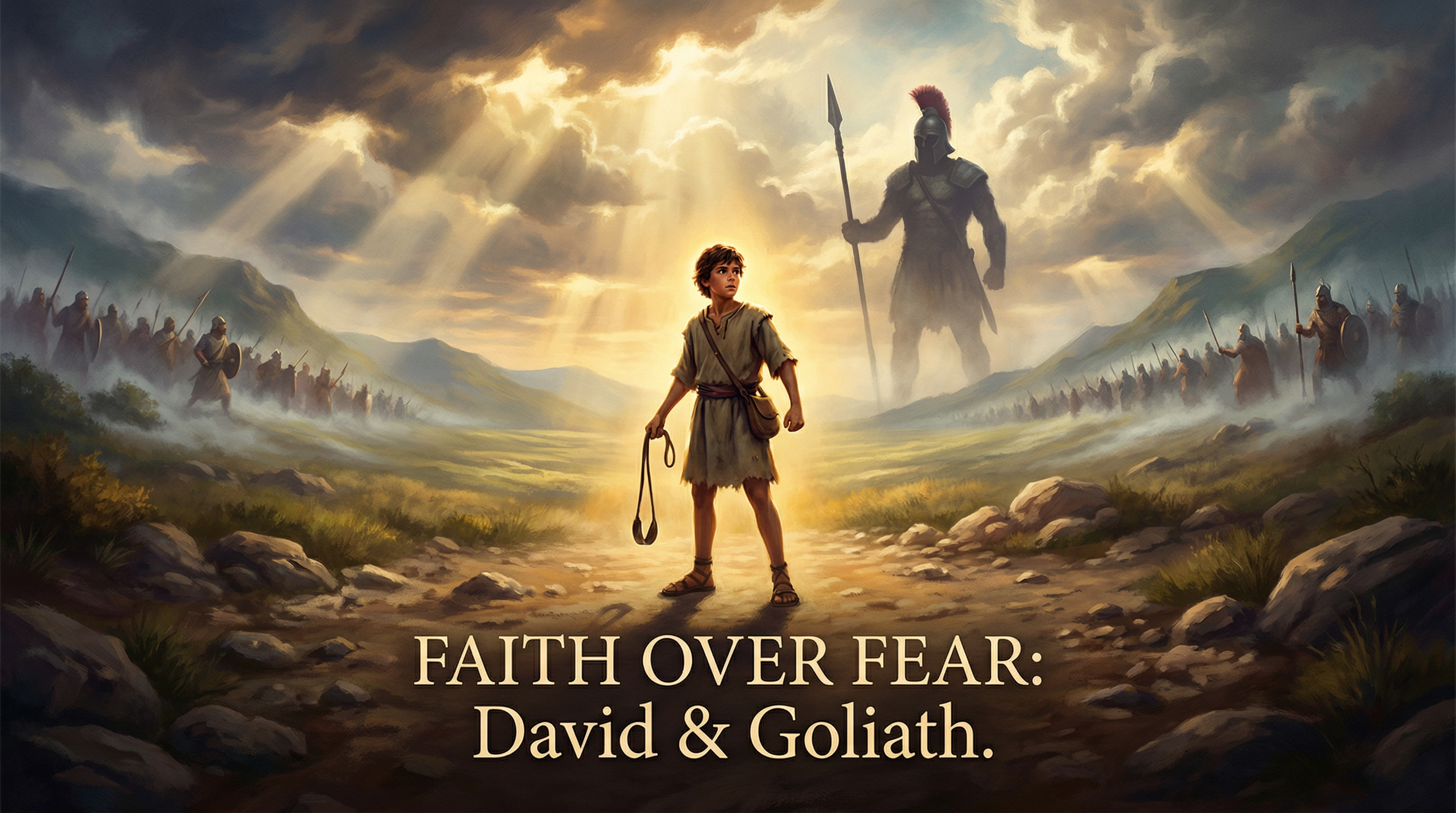
David and Goliath: Faith Over Fear
The most famous battle in biblical history reveals profound truths about faith, courage, and the power of God. Discover why David's victory over Goliath still resonates today.
David and Goliath: Faith Over Fear
The story of David and Goliath is perhaps the most famous narrative in the entire Bible. It has become a cultural touchstone, a metaphor for any underdog facing overwhelming odds. But beneath the familiar surface of this story lies profound spiritual truth about the nature of faith, the source of true courage, and the power of God to work through the most unlikely instruments.
The Crisis in the Valley
The scene opens in the Valley of Elah, where the armies of Israel and the Philistines face each other across a ravine. The Philistines, Israel's perennial enemies, have brought their champion—a giant named Goliath from the city of Gath.
The biblical description of Goliath is staggering:
"A champion named Goliath, who was from Gath, came out of the Philistine camp. His height was six cubits and a span. He had a bronze helmet on his head and wore a coat of scale armor of bronze weighing five thousand shekels; on his legs he wore bronze greaves, and a bronze javelin was slung on his back. His spear shaft was like a weaver's rod, and its iron point weighed six hundred shekels." (1 Samuel 17:4-7)
Goliath stood over nine feet tall, covered in armor weighing 125 pounds, carrying weapons that no ordinary man could wield. He was a walking tank, a professional warrior who had likely been training for combat since childhood.
For forty days, Goliath issued the same challenge: "Choose a man and have him come down to me. If he is able to fight and kill me, we will become your subjects; but if I overcome him and kill him, you will become our subjects and serve us" (1 Samuel 17:8-9).
It was a challenge to single combat, a common practice in the ancient world that could decide the outcome of a battle without massive bloodshed. But there was one problem: no one in Israel's army was willing to face Goliath.
The Paralysis of Fear
The text tells us that "Saul and all the Israelites were dismayed and terrified" (1 Samuel 17:11). Here was an entire army—thousands of trained soldiers—paralyzed by fear of one man.
Why were they so afraid? The obvious answer is Goliath's size and strength. But there was something deeper at work. The Israelites had forgotten who they were and whose they were.
They had forgotten that they were the people of the living God, the same God who had parted the Red Sea, brought down the walls of Jericho, and given them victory over countless enemies. They were looking at Goliath through human eyes, measuring him by human standards, and concluding that he was unbeatable.
This is the nature of fear: it causes us to focus on the size of the problem rather than the power of God. It makes giants look bigger and God look smaller.
The Shepherd Boy Arrives
Into this scene of fear and paralysis comes David, sent by his father to bring food to his brothers and check on their welfare. When he arrives at the battle line and hears Goliath's challenge, his response is immediate and revealing:
"Who is this uncircumcised Philistine that he should defy the armies of the living God?" (1 Samuel 17:26)
Notice David's perspective. He doesn't focus on Goliath's size or strength. He focuses on two things: Goliath's spiritual status (uncircumcised, outside the covenant) and God's character (the living God).
Where others saw an unbeatable giant, David saw a covenant-breaker defying the covenant God. Where others saw impossible odds, David saw an opportunity for God to demonstrate His power.
This is the perspective of faith: it sees reality through God's eyes rather than human eyes. It measures challenges not by human resources but by divine power.
[Content continues with full sections on Opposition, Wrong Armor, The Battle, Aftermath, Lessons, and Conclusion...]
In our next study, we will explore David's entry into Saul's court and the beginning of his complex relationship with Israel's troubled king.