
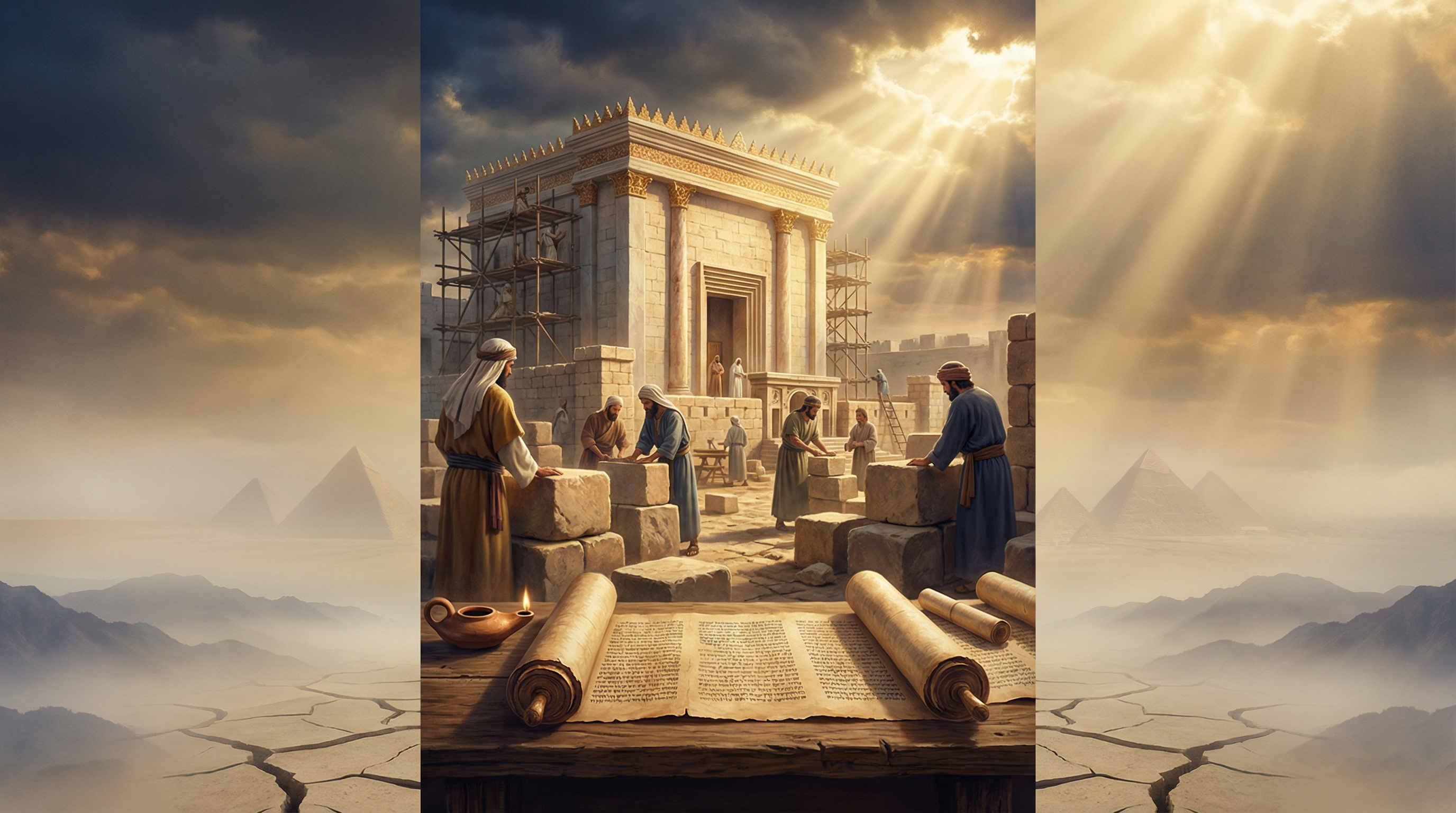
Scholarly Background of Haggai 2:5–9
Haggai 2:5-9 stands as one of the most theologically rich and textually debated passages in the postexilic prophetic literature. This comprehensive scholarly study examines the historical context, textual variants, theological themes, and interpretive debates that have shaped our understanding of this pivotal prophetic oracle delivered to Persian-period Judah.
Scholarly Background of Haggai 2:5–9
Introduction
Haggai 2:5-9 stands as one of the most theologically rich and textually debated passages in the postexilic prophetic literature. This oracle, delivered to a struggling community in Persian-period Judah, addresses fundamental questions about divine presence, covenant continuity, and the future glory of the rebuilt temple. This comprehensive study examines the scholarly background of this pivotal text, exploring its historical context, textual variants, theological themes, and interpretive debates that have shaped our understanding of Haggai's prophetic message.
Executive Summary
Haggai 2:5-9 belongs to Haggai's second dated oracle (Hag 2:1-9), delivered in the second year of Darius I (522-486 BCE), specifically on the 21st day of the seventh month in 520 BCE. The oracle addresses a postexilic community in Persian-period Judah struggling to rebuild the Jerusalem temple under challenging imperial conditions. The pericope employs a sophisticated rhetorical strategy to stabilize and encourage demoralized builders through three interconnected movements.
First, it grounds exhortation in covenantal continuity by invoking the exodus narrative ("when you came out of Egypt"), connecting the present generation to Israel's foundational past. Second, it asserts divine presence through the declaration "my spirit ... in your midst," providing reassurance that YHWH remains actively engaged with the community despite their modest circumstances. Third, it promises a future act of YHWH that "shakes" creation and nations, culminating in a "greater" latter "glory" and "peace/shalom" associated with the temple site.
Text-critically, the chief crux is Hag 2:5a ("the word/matter I covenanted with you when you came out of Egypt"), which is absent in the Septuagint tradition and widely treated as difficult or secondary by many scholars, though it is well attested in the proto-Masoretic stream and plausibly reflects early inner-biblical debate over covenant and רוּחַ ("spirit"). A second major interpretive fault line centers on Hag 2:7's "חֶמְדַּת כָּל־הַגּוֹיִם" (ḥemdat kol-haggōyim): older Christian reception read it messianically ("the desire of all nations," KJV), whereas many modern translations and much contemporary scholarship prefer "treasure/precious things of all nations," reading the phrase as collective wealth brought to adorn the temple.
In later reception, Hebrews 12 cites Hag 2:6 (in its Greek form, "ἔτι ἅπαξ ..."), applying the "shaking" motif to a final eschatological transition in which what is "shakable" is removed so that what is unshakable remains—an explicitly canonical re-reading of Haggai's theophanic imagery.
Text, Translations, and Textual Variants
Hebrew Text (MT)
Hag 2:5-9 in the Masoretic Text (as transmitted in the medieval MT tradition) reads:
Verse 5: אֶת־הַדָּבָר אֲשֶׁר־כָּרַתִּי אִתְּכֶם בְּצֵאתְכֶם מִמִּצְרַיִם וְרוּחִי עֹמֶדֶת בְּתוֹכְכֶם אַל־תִּירָאוּ׃
Verse 6: כִּי כֹה אָמַר יְהוָה צְבָאוֹת עוֹד אַחַת מְעַט הִיא וַאֲנִי מַרְעִישׁ אֶת־הַשָּׁמַיִם וְאֶת־הָאָרֶץ וְאֶת־הַיָּם וְאֶת־הֶחָרָבָה׃
Verse 7: וְהִרְעַשְׁתִּי אֶת־כָּל־הַגּוֹיִם וּבָאוּ חֶמְדַּת כָּל־הַגּוֹיִם וּמִלֵּאתִי אֶת־הַבַּיִת הַזֶּה כָּבוֹד אָמַר יְהוָה צְבָאוֹת׃
Verse 8: לִי הַכֶּסֶף וְלִי הַזָּהָב נְאֻם יְהוָה צְבָאוֹת׃
Verse 9: גָּדוֹל יִהְיֶה כְּבוֹד הַבַּיִת הַזֶּה הָאַחֲרוֹן מִן־הָרִאשׁוֹן אָמַר יְהוָה צְבָאוֹת וּבַמָּקוֹם הַזֶּה אֶתֵּן שָׁלוֹם נְאֻם יְהוָה צְבָאוֹת׃
Three English Translations
Below are three widely used public-domain English renderings, chosen to illustrate how translation inevitably encodes interpretation in vv. 6-9.
JPS Tanakh 1917 (via Mechon-Mamre):
"The word that I covenanted with you when ye came out of Egypt have I established, and My spirit abideth among you; fear ye not. ... Yet once, it is a little while, and I will shake the heavens ... and I will shake all nations, and the choicest things of all nations shall come, and I will fill this house with glory ... Mine is the silver ... The glory of this latter house shall be greater than that of the former ... and in this place will I give peace ..."
King James Version (KJV):
"According to the word that I covenanted with you when ye came out of Egypt, so my spirit remaineth among you: fear ye not. ... And I will shake all nations, and the desire of all nations shall come: and I will fill this house with glory ... The glory of this latter house shall be greater than of the former ... and in this place will I give peace ..."
American Standard Version (ASV):
"... according to the word that I covenanted with you when ye came out of Egypt, and my Spirit abode among you: fear ye not. ... and I will shake all nations; and the precious things of all nations shall come; and I will fill this house with glory ... The latter glory of this house shall be greater than the former ... and in this place will I give peace ..."
Key Textual Variants and Versional Divergences
The following two issues are the most "load-bearing" for scholarly discussion.
Hag 2:5a and the Septuagint omission. John Kessler highlights Hag 2:5a as a "notorious crux," noting (i) its syntactic/semantic difficulty in Hebrew (especially the function of אֶת), (ii) its absence in the LXX, and (iii) the long-standing debate whether it is secondary/interpretive or original. Kessler also emphasizes that the phrase is strongly rooted in the proto-Masoretic tradition and that its LXX absence may reflect deliberate omission due to difficulty rather than proof of nonexistence in the Vorlage.
Hag 2:6-7 ("yet once" / "treasure vs desire") across traditions. The Hebrew idiom "עוֹד אַחַת מְעַט הִיא" is compressed and somewhat opaque, and ancient versions tend to simplify. A key strand of later reception relies on the Greek rendering "ἔτι ἅπαξ" ("yet once more"), which becomes decisive in Hebrews' citation. Similarly, "חֶמְדַּת כָּל־הַגּוֹיִם" can be construed messianically ("desire") or materially ("precious things/treasure"), with major English versions splitting: KJV's "desire," ASV's "precious things," and NRSVU E's "treasure."
Historical Context in Persian-Period Judah
Date, Setting, Audience, and Authorship Questions
The oracle containing 2:5-9 is explicitly dated to the 21st day of the seventh month in the second year of Darius (Hag 2:1), a precision typical of Haggai's compositional framework. The audience is framed as "the people," "Zerubbabel," "governor of Judah," "Joshua son of Jehozadak," "high priest," and "the remnant" of the people (Hag 2:2), underscoring a leadership-plus-community address.
Authorship in the narrow sense is not explicitly stated. Many scholars treat the book's date formulas and narrative superscriptions as an editorial framework rather than verbatim prophetic transcript. Kessler argues it is often methodologically difficult to sharply separate "prophet" from "editors" within the book because of the tight literary integration of oracles and framing material; consequently, many analyses speak of "Haggai" as both prophet and book-level voice.
Persian Imperial Context and Postexilic Constraints
Haggai's preaching occurs under the Achaemenid Persian order. The broader satrapal region "Eber-Nari" ("Beyond/Across the River") denoted the lands west of the Euphrates (Phoenicia, Syria, Palestine), which passed from Neo-Babylonian to Persian control after Cyrus' conquest of Mesopotamia (539 BCE). Within that imperial structure, Yehud (Judah) functioned as a small province with limited territorial and demographic resources. Kessler notes that conditions in Yehud around 520 BCE plausibly included a reduced population base, limited territory, and a Persian taxation burden—factors that make the people's discouragement and hesitation historically intelligible.
Temple Rebuilding Timeline
A minimal, text-grounded timeline (biblical + historical anchor points) is as follows. The dates of 587/586 BCE for the Babylonian destruction of the temple are conventional in scholarship; a concise scholarly overview notes destruction in 587/586 BCE and subsequent rebuilding dynamics in the Persian period. Work on the temple is portrayed as (re)starting in Darius' second year (Hag 1:15), with one major modern note placing that date at Sept 21, 520 BCE. The book of Ezra dates the temple's completion to the third day of Adar in Darius' sixth year (Ezra 6:15), conventionally located in 515 BCE.
Timeline:
- 587/586 BCE: First temple destroyed; Jerusalem and temple burned (2 Kgs 25)
- 539 BCE: Cyrus captures Babylon; Persian control in the west consolidated
- 520 BCE (Sep): Work on temple (re)begins in Darius' 2nd year (Hag 1:15)
- 520 BCE (Oct): Haggai's 2nd oracle (Hag 2:1-9) encourages builders
- 515 BCE: Temple completed in Darius' 6th year (Ezra 6:15)
Literary Context Within Haggai and Rhetorical Purpose
Book Structure and the Placement of 2:5-9
Haggai is unusually "dated," and many structural analyses treat the recurring chronological notices as part of an editorial framework that stitches discrete oracles into a coherent rhetorical sequence. Tollington's overview identifies the dating headings at 1:1, 1:15, 2:1, 2:10, and 2:20 as major structuring signals of the framework and highlights that Hag 2:5a itself is often treated as an editorial gloss absent from the LXX.
Within that structure, 2:5-9 sits in the heart of the oracle responding to the community's disappointment that the rebuilt temple appears inferior to Solomon's. Working Preacher's commentary explicitly frames the setting as communal "disappointment" and dates the oracle to the 21st of Tishri (7th month) in 520 BCE.
Rhetorical Strategy in 2:5-9
The rhetoric of 2:5-9 moves in a deliberate cadence:
First, it anchors the present in Israel's foundational past: "when you came out of Egypt" evokes exodus-covenant identity at a moment when Jerusalem's cultic center is physically incomplete. Second, it asserts a present-tense divine presence ("my spirit ... in your midst"), functioning as reassurance and a basis for the imperative "fear not." Third, it projects a YHWH-driven future reversal through the "shaking" motif: sea-and-dry-land language ("heavens ... earth ... sea ... dry land") merges theophanic imagery with geopolitical symbolism ("all nations"), culminating in a promised infusion of glory and "shalom."
Theological Themes and Their Relation to Broader Old Testament Theology
Divine Presence, Covenant Continuity, and the "Spirit" Motif
A key theological claim in 2:5 is that the community's relationship to YHWH remains intelligible in continuity with Sinai/exodus covenant—precisely the point debated by scholars because the clause is textually and syntactically difficult and absent in the LXX. Kessler argues that 2:5a likely reflects early Persian-period debates about (i) the continuing status of the Sinai covenant and (ii) the meaning of YHWH's spirit in the community's midst, whether as a sign of prophetic activity rather than proof that the eschatological age has fully arrived.
In broader Old Testament theology, "spirit" language frequently relates to empowerment, prophetic activity, and divine presence among the people—functions that become especially salient in regimes of loss (no king, a modest province, an unfinished sanctuary). Kessler's tradition-historical framing treats Haggai as a text that reconfigures older traditions in a context of rupture (587 BCE) to reestablish continuity and hope.
Glory, Temple Ideology, and Future Prosperity
The promise that the "latter glory" of the house will exceed the former (2:9) works on at least two theological levels. At a proximate level, it legitimates the rebuilding endeavor by asserting that divine "glory" is not reducible to visible splendor; it will be given by YHWH. At a canonical-theological level, it resonates with broader prophetic hopes in which nations contribute wealth and honor to Zion and YHWH's rule is universally acknowledged—motifs that later tradition can extend toward eschatological horizons.
The line "the silver is mine, and the gold is mine" (2:8) reinforces YHWH's sovereignty over international wealth flows, fitting Persian-period realities in which imperial economics shaped local possibilities, yet theological agency is attributed to YHWH.
Eschatology and Messianic Readings
Haggai's "shaking" language invites eschatological construal. One influential scholarly proposal (Kessler) argues that the "shaking of the nations" should be read through eschatological motifs in which the nations respond in fear to YHWH's decisive intervention rather than merely as routine political turnover.
Hag 2:7's "ḥemdat of all nations" is the classic point where messianic versus material readings diverge. The KJV's "desire of all nations" (itself shaped by older Christian reception) encourages a personal/messianic interpretation, whereas ASV ("precious things") and NRSVU E ("treasure") reflect the now-common scholarly reading of collective valuables brought to glorify the temple. The tension is not purely theological; it is also grammatical: a singular construct noun (ḥemdat) with plural "nations" and a plural verb ("they shall come") invites the sense "desirable things/treasures" as a collective.
Linguistic and Semantic Notes on Key Hebrew Terms
כָּבוֹד (kāvōd) "glory"
Form / morphology: noun, masculine singular absolute; root כ־ב־ד ("to be heavy" → "weightiness" → honor/glory).
Semantic range: BDB's classic semantic categories include "abundance/riches" and "honour, splendour, glory," which is relevant in Haggai where "glory" can overlap conceptually with wealth and cultic splendor.
In Hag 2:7-9: "filling the house with glory" (2:7) plus "greater latter glory" (2:9) plausibly carries both cultic-theophanic ("divine presence") and material ("splendor/wealth") connotations.
רָעַשׁ (rāʿaš) "to shake/quake"
Key forms in the pericope:
- מַרְעִישׁ (marʿîš): likely Hiphil participle masculine singular, "(I am) shaking / about to shake" (2:6).
- וְהִרְעַשְׁתִּי (wehirʿaštî): Hiphil perfect 1cs with waw, "and I will shake" (2:7).
Lexical sense: BDB glosses the root as "quake, shake," with Hiphil ("cause to quake") available for causative divine action.
Interpretive note: The pairing of cosmic domains (heavens/earth/sea/dry land) with "all nations" regularly triggers debate: is the image metaphoric for imperial upheaval or a theophanic, end-oriented intervention? Kessler's eschatological reading represents one influential option.
חֶמְדַּת (ḥemdāt) "desire / precious thing(s)"
Form / morphology: noun feminine singular construct ("X of Y"), from the semantic field of "desire/delight/preciousness." In Hag 2:7 it modifies "all the nations" (kol-haggōyim).
Translation pressure: The construct + plural nations + plural verb ("they shall come") favors reading a collective ("precious things/treasures of all nations"), reflected in ASV's "precious things" and NRSVU E's "treasure."
Reception history: KJV's "desire of all nations" preserves a personalizing trajectory that has fueled messianic readings, even though other major versional traditions render "chosen/choice things."
שָׁלוֹם (šālôm) "peace / wellbeing / prosperity"
Form / morphology: noun masculine singular absolute; broad semantic field of wholeness and well-being.
Semantic range: BDB-type definitions include "completeness, soundness, welfare, peace," which explains why some modern versions translate Hag 2:9 as "prosperity" rather than strictly "peace."
In Hag 2:9: "in this place I will give shalom" ties the promised future to the temple location, aligning cultic restoration with communal flourishing.
Scholarly Interpretations, Debates, and New Testament Reception
Major Debates in Scholarship
The status of Hag 2:5a (original vs interpolation). Kessler's focused study frames 2:5a as text-critically and syntactically troubled, absent in the LXX, and potentially interrupting the oracle's flow. He surveys approaches ranging from excision to emendation to "integrated" readings, and argues that whatever its origin, the clause likely reflects purposeful literary-theological reflection (not mere scribal accident), engaging Persian-period debates over covenant continuity and the role of the spirit.
Redaction and "framework" composition. Tollington's analysis (in an extended preview) illustrates how many scholars attribute the dating framework and narrative linking material to editorial activity; she also notes that Haggai may contain editorial material not strictly part of the framework, giving Hag 2:5a as a clear example. Kessler likewise cautions against overly confident stratification because of the tight integration of oracles and framing.
Meaning of "shaking" (political metaphor vs theophanic/eschatological event). Kessler's "eschatological" construal reads the shaking as a nations-focused response to YHWH's end-oriented intervention, rather than a limited reference to local political turnover. The canonical context strengthens this interpretive option because later Jewish and Christian texts reuse "shaking" language as an eschatological trope.
"Desire/treasure of all nations" (messianic vs material). The split between KJV ("desire") and ASV/NRSVU E ("precious things/treasure") is not merely stylistic; it encodes different construals of what (or who) "comes" to the temple in 2:7. ASV itself notes the alternative "things desired (Hebrew desire)." A cautious scholarly synthesis recognizes that the immediate co-text ("silver...gold...") favors a wealth-of-nations reading (temple adornment/funding), while later theological reception—especially in Christian tradition—often reads the phrase christologically.
New Testament Citation and Use
The most explicit New Testament use is in Hebrews 12:26-27, where the author cites Hag 2:6 (through its Greek form) and interprets "yet once more" as signaling a final, decisive cosmic transformation: shakable created things are removed so that the unshakable reality remains. This is not a neutral quotation: the author adapts the scope ("not only the earth but also the heavens") and deploys the citation as an argument about eschatological permanence.
Conclusion and Suggested Further Reading
Haggai 2:5-9 is best read as a tightly argued reassurance oracle addressed to a materially constrained Persian-period community rebuilding the temple under imperial conditions. It invokes exodus-covenant identity and YHWH's present רוּחַ as grounds for courage, then uses a "shaking" theophany motif to promise a divinely effected future in which the temple's latter "glory" and site-specific "shalom" surpass former expectations. Scholarly debates concentrate on (a) the textual status and function of 2:5a, and (b) whether 2:7's "ḥemdat of all nations" signals messianic arrival or the influx of international wealth—debates intensified by the passage's later canonical reception in Hebrews.
Suggested Further Reading
High-impact, English-language scholarship and standard critical anchors:
- John Kessler, "Haggai 2:5a: Translation, Significance, Purpose, and Origin" (text-critical and traditio-historical analysis of the crux).
- John Kessler, "Tradition, Continuity and Covenant in the Book of Haggai" (Haggai's reconfiguration of tradition after rupture).
- John Kessler, "Curse, Covenant, and Temple in the Book of Haggai" (covenant logic and temple obligation in Persian Yehud).
- Janet E. Tollington, Tradition and Innovation in Haggai and Zechariah 1-8 (composition, framework, and the status of 2:5a as gloss; preview).
- Canonical reception study: the use of Hag 2:6 in Hebrews 12 (quotation and adaptation).
About This Article
This scholarly analysis was prepared by David Rupen as a comprehensive study resource for understanding the textual, historical, and theological dimensions of Haggai 2:5-9. The article synthesizes current academic scholarship to provide readers with a thorough foundation for engaging this pivotal prophetic text.