
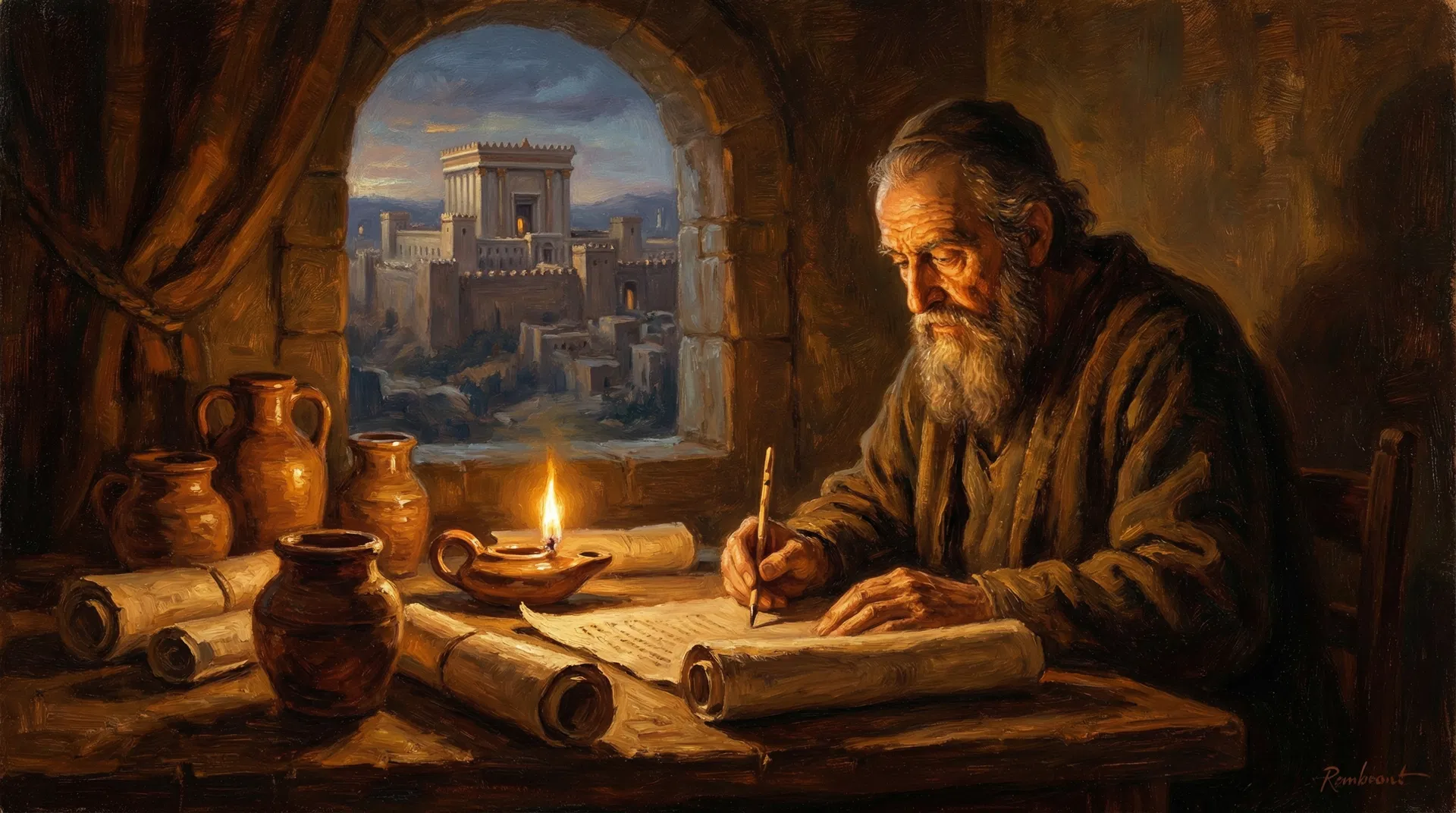
Baruch Son of Neriah — The Faithful Scribe: A Historical and Theological Study
A comprehensive scholarly study of Baruch son of Neriah — Jeremiah's faithful scribe. Covering his historical context in 7th–6th century BCE Judah, his pivotal role in Jeremiah 36 (the burning and rewriting of the scroll), the intimate personal oracle of Jeremiah 45, archaeological evidence from his clay seal bullae, and enduring lessons about faithful service, misplaced ambition, and God's presence in dark times.
Section 1: Introduction — The Man Behind the Scroll
In the annals of biblical history, few figures occupy as paradoxical a position as Baruch son of Neriah. He is, at once, one of the most important individuals in the entire Hebrew Bible and one of the least celebrated. Without Baruch, the Book of Jeremiah as we know it would not exist. Without Baruch, the scroll that Jeremiah dictated — the very word of God — might have been lost to the flames of Jehoiakim's brazier and never rewritten. Without Baruch, the legal transaction that symbolised Judah's hope for restoration (Jeremiah 32) would have had no witness to carry it forward. And yet, for all his indispensable service, Baruch lived in the shadow of the prophet he served, carrying burdens that were not his own, suffering consequences for words he did not originate, and wrestling with a profound personal crisis that God Himself saw fit to address in one of the most intimate oracles in all of Scripture — Jeremiah 45.
This study examines Baruch ben Neriah in the full light of his historical context, his literary and scribal role, the extraordinary archaeological evidence that confirms his existence, and the enduring theological lessons that emerge from his life. He is a figure for every believer who has ever served faithfully in obscurity, carried the weight of another's calling, or wrestled with the gap between their own ambitions and God's assignment.
Section 2: Historical Context — Judah on the Brink of Catastrophe
To understand Baruch, one must first understand the world into which he was born. Baruch's active ministry spans approximately 605 BCE to the years following the fall of Jerusalem in 586 BCE — a period of roughly two decades during which the Kingdom of Judah lurched from one crisis to another before finally collapsing under the weight of Babylonian conquest.
The late seventh century BCE was a period of seismic geopolitical upheaval in the ancient Near East. The Assyrian Empire, which had dominated the region for over a century, was in terminal decline. The Babylonian Empire under Nabopolassar and then his son Nebuchadnezzar II was rapidly filling the power vacuum. Egypt, under Pharaoh Necho II, attempted to reassert its influence in the Levant, leading to the fateful Battle of Megiddo in 609 BCE, where the righteous King Josiah of Judah was killed. Josiah's death was a catastrophe for Judah — not merely politically, but spiritually. He had been the last king to pursue genuine covenant faithfulness, and with his death, the fragile religious reforms he had championed began to unravel.
The four kings who followed Josiah — Jehoahaz, Jehoiakim, Jehoiachin, and Zedekiah — were each, in their own way, failures. Jehoiakim (609–598 BCE), who features prominently in Baruch's story, was installed by Pharaoh Necho as a puppet king and later transferred his allegiance to Nebuchadnezzar. He was described in the biblical record as a man who "did evil in the sight of the LORD" (2 Kings 23:37), who taxed his people oppressively to pay tribute to Egypt, and who was so contemptuous of the prophetic word that he literally cut it apart and burned it in a fire (Jeremiah 36:23).
It was into this volatile, dangerous world that Baruch entered Jeremiah's service. The prophet had been preaching for decades — since the thirteenth year of Josiah's reign (Jeremiah 1:2), approximately 627 BCE — and had accumulated a body of prophetic oracles that needed to be preserved and disseminated. The partnership between Jeremiah and Baruch was not merely a professional arrangement; it was a providential collaboration through which the word of God would survive the fires of royal opposition and the catastrophe of national destruction.
Section 3: Who Was Baruch? — Family, Status, and Scribal Identity
Baruch is identified in the biblical text as "Baruch son of Neriah son of Mahseiah" (Jeremiah 32:12; 36:4). This three-generation genealogy is significant. In the ancient Near East, genealogical depth indicated social standing. The mention of his grandfather Mahseiah suggests that Baruch came from a family of some prominence in Jerusalem.
The historian Josephus describes Baruch as a Jewish aristocrat (Antiquities 10.9.1), and this assessment is supported by what we know of his family connections. His brother, Seraiah ben Neriah, held the position of "quartermaster" or "chief chamberlain" (sar menuḥah) to King Zedekiah (Jeremiah 51:59) — a position of significant royal responsibility. That both brothers occupied roles of influence, one in the royal court and one in the prophetic circle, suggests a family with deep roots in the administrative and intellectual life of Jerusalem.
The title sōpēr — "scribe" — that Baruch bears in the biblical text and on his seal is not merely a description of a copyist or secretary. In the ancient Near East, and particularly in Judah, the scribe was a trained professional who occupied a crucial position in the administrative, legal, and religious life of society. Scribes were educated in the royal and temple schools, trained in the arts of writing, legal drafting, and the preservation of texts. They were, in many respects, the intellectual backbone of the ancient state.
Baruch's scribal training would have equipped him to do far more than simply copy Jeremiah's words. He would have been capable of composing, editing, and arranging texts — skills that many scholars believe he brought to bear on the final form of the Book of Jeremiah itself. The German scholar Sigmund Mowinckel famously proposed that the biographical narratives in Jeremiah (what he called "Source B") were composed by Baruch, and this view, while debated, continues to command significant scholarly support. Richard Elliott Friedman, in his influential work Who Wrote the Bible?, went further, proposing that Baruch was the Deuteronomist — the editor responsible for the final form of the books from Deuteronomy through 2 Kings. While this claim goes beyond what the evidence can definitively establish, it reflects the scholarly consensus that Baruch was not merely a passive recorder but an active literary figure of considerable importance.
Section 4: Jeremiah 36 — The Scroll, the Fire, and the Rewriting
The most dramatic episode in Baruch's life is recorded in Jeremiah 36, and it deserves careful attention both as a narrative and as a theological statement.
The chapter opens with a divine command in the fourth year of Jehoiakim (605 BCE) — the same year that Nebuchadnezzar defeated the Egyptians at the Battle of Carchemish and established Babylonian hegemony over the ancient Near East. The timing is not coincidental. The world was changing, and God commanded Jeremiah to commit his oracles to writing: "Take a scroll of a book and write on it all the words that I have spoken to you against Israel, against Judah, and against all the nations, from the day I spoke to you, from the days of Josiah even to this day" (Jeremiah 36:2).
Jeremiah was apparently under some form of restriction that prevented him from entering the Temple precincts (v. 5). This is where Baruch becomes indispensable. Jeremiah dictated; Baruch wrote. The process of dictation and transcription was not a simple mechanical exercise. The scroll Baruch produced represented years of prophetic ministry — oracles of warning, lament, judgment, and hope — compressed into a single document. When Baruch had finished writing, Jeremiah gave him a specific commission: "Go and read from the scroll which you have written from my mouth, the words of the LORD, in the hearing of the people in the LORD's house on the day of fasting" (v. 6).
Baruch did exactly as he was commanded. On a fast day in the ninth month of the fifth year of Jehoiakim (approximately December 604 BCE), he read the scroll publicly in the chamber of Gemariah son of Shaphan — a scribe and royal official whose own seal has been recovered by archaeologists (see Section 6). The reading was heard by Micaiah son of Gemariah, who reported it to the princes gathered in the royal palace. The princes summoned Baruch and had him read the scroll again. Their response was one of fear: "We will surely tell the king of all these words" (v. 16). They advised Baruch and Jeremiah to hide.
What followed was one of the most extraordinary acts of royal defiance in the biblical record. The scroll was brought to King Jehoiakim, who was sitting in his winter house with a fire burning before him. As Jehudi read three or four columns of the scroll, the king took a penknife and cut them off, throwing them into the fire. He continued until the entire scroll was consumed. The text notes with devastating understatement: "Yet they were not afraid, nor did they tear their garments, the king nor any of his servants who heard all these words" (v. 24). Three of the princes — Elnathan, Delaiah, and Gemariah — urged the king not to burn the scroll, but he refused to listen.
The theological significance of this act cannot be overstated. Jehoiakim was not merely destroying a document; he was attempting to destroy the word of God. He was enacting, in physical form, the spiritual posture of a generation that had rejected the prophetic word. But the word of God cannot be destroyed. God's response was immediate and definitive: "Take yet another scroll, and write on it all the former words that were in the first scroll which Jehoiakim the king of Judah has burned" (v. 28). Jeremiah dictated again; Baruch wrote again. And this time, the text notes, "there were added besides to them many similar words" (v. 32). The attempt to silence the word of God produced a more complete and expanded version of it.
For Baruch, this episode was both a demonstration of his courage and a source of profound personal danger. Jehoiakim had issued a command to arrest both Jeremiah and Baruch (v. 26). They were hidden — "the LORD hid them" (v. 26) — but the threat was real. To serve as Jeremiah's scribe was not a safe occupation. It was an act of faith that carried the possibility of imprisonment or death.
Section 5: Jeremiah 45 — The Personal Oracle and the Crisis of Ambition
Chapter 45 of Jeremiah is one of the most unusual passages in the entire prophetic corpus. It is a personal oracle — addressed not to a nation, not to a king, not to a city, but to a single individual: Baruch son of Neriah. It is also one of the most psychologically penetrating passages in the Old Testament, revealing with remarkable candour the interior life of a man who was struggling under the weight of his calling.
The oracle is dated to the same year as the events of Jeremiah 36 — the fourth year of Jehoiakim (605 BCE). This is significant. It means that God's word to Baruch came at the very moment when Baruch was most deeply engaged in the dangerous work of writing and reading the scroll. The personal cost of that work was evidently taking a toll.
God quotes Baruch's own words back to him: "You said, 'Woe is me now! For the LORD has added grief to my sorrow. I fainted in my sighing, and I find no rest'" (v. 3). The five personal pronouns in this lament — "me," "my," "my," "I," "I" — reveal a man whose suffering has become intensely self-focused. This is not a criticism of Baruch's pain, which was real and legitimate. It is, rather, a diagnosis of a spiritual condition that God was about to address.
God's response to Baruch's lament contains both a rebuke and a promise. The rebuke is gentle but direct: "And do you seek great things for yourself? Seek them not" (v. 5a). This single question cuts to the heart of Baruch's crisis. He was not merely exhausted; he was disappointed. He had expected that his service to Jeremiah — his education, his family connections, his scribal skills — would lead to recognition, advancement, and perhaps even the gift of prophecy. Instead, he found himself a fugitive, writing scrolls that kings burned and reading words that put his life at risk.
The commentator David Guzik notes that Baruch's brother Seraiah held a position of honour in the royal court. Baruch, by contrast, had aligned himself with an unpopular prophet and was now in hiding. The gap between his expectations and his reality was the source of his grief. He was seeking "great things for himself" — not in a crude, selfish sense, but in the very human sense of wanting his life to amount to something significant, to be recognised and honoured for his service.
God's answer to this ambition is not a denial of Baruch's worth, but a reorientation of his perspective. The context is everything: "Behold, what I have built I will break down, and what I have planted I will pluck up, that is, this whole land" (v. 4). God is about to judge Judah. The entire social and political order that Baruch had grown up in — the royal court, the temple establishment, the aristocratic families of Jerusalem — was about to be dismantled. In such a context, to seek personal greatness was to seek the wrong thing in the wrong place at the wrong time.
The promise that accompanies the rebuke is both modest and profound: "But I will give your life to you as a prize in all places, wherever you go" (v. 5b). The image is of a soldier who barely escapes with his life after a defeat in battle. God was not promising Baruch fame, honour, or prophetic gifts. He was promising him something far more precious in the circumstances: survival. In a world that was about to collapse, the promise of life was the greatest gift God could give.
And yet, as the commentator Derek Kidner observed, what God left unsaid was that Baruch would earn the gratitude of every generation for what he dared to do. The man who was told not to seek great things for himself became, through his faithful service, one of the most consequential figures in the history of the Hebrew Bible.
Section 6: Archaeological Evidence — The Seal of Baruch
One of the most remarkable aspects of Baruch's story is that it is confirmed by direct archaeological evidence. In 1975, a clay bulla — a small stamped seal impression used to authenticate documents — appeared on the antiquities market. Its purchaser, a prominent Israeli collector, permitted the distinguished archaeologist Nahman Avigad to publish it. The bulla measures approximately 17 by 16 millimetres and is stamped with an oval seal bearing the inscription, in ancient Hebrew script:
| Line | Transliteration | Translation |
|---|---|---|
| 1 | lbrkyhw | Belonging to Berachyahu |
| 2 | bn nryhw | son of Neriyahu |
| 3 | hspr | the scribe |
The name "Berachyahu" is the longer theophoric form of "Baruch" — the addition of the divine suffix -yahu (a form of the divine name YHWH) was common in Hebrew names of this period. "Neriyahu" is similarly the longer form of "Neriah." The identification with Jeremiah's scribe is thus unambiguous: this is the seal of Baruch son of Neriah, the scribe.
In 1996, a second bulla with an identical inscription appeared — presumably stamped by the same seal. This second bulla bore something even more extraordinary: a fingerprint. The biblical scholar Hershel Shanks, among others, speculated that this fingerprint might be that of Baruch himself — a direct physical trace of the man who wrote down the words of Jeremiah.
The authenticity of these bullae was initially disputed by some scholars, who raised concerns about their provenance (they were acquired on the antiquities market rather than in a controlled excavation). However, a 2016 scholarly investigation rebutted the earlier concerns, demonstrating that the bullae showed reverse imprints of wood grain and string consistent with ancient document-sealing techniques not known to modern science until decades after the bullae were purchased. The Armstrong Institute of Biblical Archaeology notes that the bullae are now widely regarded as authentic, and they are housed in the Israel Museum in Jerusalem.
The broader archaeological context is equally significant. The bullae of Baruch's contemporaries — Gemariah son of Shaphan (Jeremiah 36:10), Seraiah son of Neriah (Baruch's own brother), and others mentioned in the Book of Jeremiah — have also been recovered. Together, these tiny clay seals form a remarkable archaeological constellation, confirming the historical reality of the world described in the Book of Jeremiah with extraordinary precision.
Section 7: Baruch's Subsequent History — Egypt and Beyond
After the fall of Jerusalem in 586 BCE, Baruch's story continues in the final chapters of the Book of Jeremiah. Following the assassination of Gedaliah, the Babylonian-appointed governor of Judah, a remnant of the Judean population sought to flee to Egypt for safety. Jeremiah counselled them to remain in the land, but they refused. Significantly, they accused Baruch of influencing Jeremiah against them: "Baruch son of Neriah is inciting you against us to hand us over to the Babylonians" (Jeremiah 43:3). This accusation, though false, reveals how prominent Baruch had become in the eyes of the people — he was seen as a figure of real influence, not merely a passive secretary.
Both Jeremiah and Baruch were taken to Egypt against their will (Jeremiah 43:6). According to a tradition preserved by Jerome, Baruch died in Egypt. Two other traditions, however, state that he was later carried to Babylon by Nebuchadnezzar after the Babylonian conquest of Egypt, and that he eventually made his way to Babylon, where he taught the Torah to Ezra. The Talmud includes Baruch among the prophets and states that he prophesied in the period following the destruction of Jerusalem.
The deuterocanonical Book of Baruch, accepted as canonical by the Catholic and Eastern Orthodox traditions but not included in the Protestant canon, is attributed to Baruch and purports to be a letter sent from Babylon to the exiles in Jerusalem. While most modern scholars regard it as a pseudonymous composition from a later period, it testifies to the enduring reverence in which Baruch was held by subsequent generations.
Section 8: Theological Themes and Lessons for Today
The life of Baruch son of Neriah is a rich source of theological reflection, offering lessons that are as relevant to the contemporary believer as they were to the people of Judah in the sixth century BCE.
The Dignity of Supporting Roles
Baruch's primary calling was to support another man's ministry. He was not the prophet; Jeremiah was. He was not the one who received the visions, heard the divine voice, or stood before kings with the word of the LORD. He was the one who wrote it down, read it aloud, preserved it, and transmitted it. In the economy of God's kingdom, this supporting role was not secondary or inferior — it was indispensable. The word of God that Baruch preserved has shaped the faith of billions of people across three millennia. His name is known in every tradition that honours the Hebrew Bible. The "great things" he was told not to seek came to him anyway, not through self-promotion, but through faithful service.
The Danger of Misplaced Ambition
Jeremiah 45 is one of the most honest passages in Scripture about the spiritual danger of ambition. Baruch was not a wicked man; his ambitions were not corrupt in any obvious sense. He wanted his life to matter, to be recognised, to achieve something commensurate with his education and abilities. These are deeply human desires. But God's word to him — "Do you seek great things for yourself? Seek them not" — is a word that cuts across every generation. The pursuit of personal greatness, even in the service of God, can become a source of spiritual exhaustion and disillusionment when the greatness we seek is not the greatness God is building.
The application is not that ambition is always wrong, or that believers should have no aspirations. The Apostle Paul was, by any measure, an ambitious man — but his ambition was directed entirely toward the glory of God and the advance of the gospel. The distinction that Baruch's story draws is between ambition for God's purposes and ambition for one's own recognition. The former is a virtue; the latter is a subtle form of idolatry.
Faithfulness in the Face of Opposition
Baruch faced real, physical danger for his service to Jeremiah. He read a scroll that provoked royal rage and put his life at risk. He was a fugitive, hiding from a king who wanted him arrested. He witnessed the destruction of everything he had known — the Temple, the city, the social order of Judah. And through all of it, he remained faithful. He did not abandon Jeremiah. He did not recant. He did not seek safety through compromise. His faithfulness under pressure is a model for every believer who has faced opposition for standing with the truth.
The Preservation of God's Word
The episode of the burning scroll and its rewriting is a profound theological statement about the indestructibility of God's word. Jehoiakim's knife and fire could not silence the prophetic message; they could only produce a more complete version of it. This truth has been demonstrated repeatedly in the history of the church — in the burning of Tyndale's New Testaments, in the suppression of Scripture under totalitarian regimes, in every attempt to silence the word of God. The word endures. And those who, like Baruch, dedicate themselves to its preservation and transmission participate in something that outlasts every earthly power.
The Promise of God's Presence in Dark Times
God's promise to Baruch — "I will give your life to you as a prize in all places, wherever you go" — was not a promise of prosperity, comfort, or recognition. It was a promise of presence and protection in the midst of catastrophe. For Baruch, who would witness the fall of Jerusalem, the burning of the Temple, and the exile of his people, this promise was everything. God was not promising to remove the darkness; He was promising to be present within it.
This is the promise that sustains every believer who serves in difficult circumstances. It is not the promise of an easy life or a prominent ministry. It is the promise that the God who knows our name — who hears our sighing and our "woe is me" — will be with us wherever we go.
Section 9: Conclusion — The Blessed One
The name Baruch means "blessed" — bārūḵ in Hebrew, the same root as the word used in the great blessing of Numbers 6:24: "The LORD bless you and keep you." It is a name that carries within it the entire theology of divine favour and covenant faithfulness.
Baruch son of Neriah was, in the deepest sense, a blessed man — not because his life was easy, but because he was faithful to his calling in one of the darkest periods of Israel's history. He wrote down the words that kings tried to burn. He read aloud the message that powerful men tried to silence. He stood by a prophet when standing by that prophet was dangerous. He wrestled honestly with his own ambitions and received from God a word that reoriented his entire perspective. And in the end, the man who was told not to seek great things for himself became one of the most important figures in the history of the Hebrew Bible.
His story is a reminder that the kingdom of God is built not only by prophets and apostles, but by the faithful scribes, secretaries, and supporters who serve in the shadow of others — who write the scrolls, read the words, preserve the texts, and carry the message forward. Their names may not be remembered in the way that the prophets they served are remembered. But God knows their names. And in the economy of His kingdom, their service is great.
References
- Avigad, Nahman. "Baruch the Scribe and Jerahmeel the King's Son." Israel Exploration Journal 28, no. 1/2 (1978): 52–56.
- Eames, Christopher. "Stamped Into History: The Seals of the Prophet Jeremiah." Armstrong Institute of Biblical Archaeology, February 19, 2023.
- Friedman, Richard Elliott. Who Wrote the Bible? 2nd ed. San Francisco: HarperSanFrancisco, 1997.
- Guzik, David. Enduring Word Bible Commentary: Jeremiah 45. Blue Letter Bible.
- Kidner, Derek. The Message of Jeremiah. The Bible Speaks Today. Leicester: Inter-Varsity Press, 1987.
- Mowinckel, Sigmund. Zur Komposition des Buches Jeremia. Kristiania: Jacob Dybwad, 1914.
- Thompson, J.A. The Book of Jeremiah. New International Commentary on the Old Testament. Grand Rapids: Eerdmans, 1980.
- Josephus, Flavius. Jewish Antiquities, Book X. Translated by William Whiston.
- Mooney, Britt. "Who Is Baruch in the Bible?" Christianity.com, April 12, 2024.
- Shanks, Hershel. "Fingerprint of Jeremiah's Scribe." Biblical Archaeology Review 22, no. 2 (1996): 36–38.