Revelation 4:1–11 — The Throne Room of Heaven: A Documentary Study
A comprehensive documentary-style scholarly study of Revelation 4:1–11 — the Throne Room of Heaven. Covering historical context in first-century Asia Minor, detailed verse-by-verse commentary, Old Testament connections (Ezekiel 1, Isaiah 6, Daniel 7), the four living creatures, the twenty-four elders, the trisagion, and the counter-imperial theology of John's vision.
Section 1: Opening Narrative — A Door Standing Open in Heaven
Picture the scene: the island of Patmos, a rocky outcrop in the Aegean Sea, where an elderly man named John — the last surviving apostle of Jesus Christ — has been exiled for his faith. Around him, the Roman Empire stretches its iron grip across the known world. Emperors demand worship. Christians are being hunted, imprisoned, and killed. The seven churches of Asia Minor, to whom John has just finished writing, are struggling under pressure, compromise, and the threat of annihilation.
And then — in the Spirit — John looks up.
"After these things I looked, and behold, a door standing open in heaven. And the first voice which I heard was like a trumpet speaking with me, saying, 'Come up here, and I will show you things which must take place after this'" (Revelation 4:1).
This single verse represents one of the most dramatic transitions in all of Scripture. The narrative of Revelation pivots from the earthly — from letters to struggling churches — to the cosmic. John is not merely receiving a vision; he is being transported in the Spirit to the very throne room of the universe. What he sees there will define everything that follows in the Book of Revelation: the seal judgments, the trumpet blasts, the bowl of wrath, the fall of Babylon, and ultimately the new creation. Before any of those events can be understood, the reader must first see what John sees — the sovereign God enthroned in glory, surrounded by worship that never ceases.
Revelation 4 is not a prelude to the drama. It is the foundation upon which the entire drama rests. Everything that unfolds in the subsequent chapters proceeds from this throne. Every judgment is issued from this throne. Every act of redemption is accomplished before this throne. The Throne Room of Heaven is, in the truest sense, the centre of the universe.
Section 2: Historical Context — Heaven Against Empire
To fully appreciate the power of Revelation 4, one must understand the world in which it was written. Scholars broadly date the composition of Revelation to approximately AD 90–95, during the reign of the Emperor Domitian (AD 81–96). This was a period of intensifying pressure on Christians throughout the Roman Empire, particularly in the province of Asia Minor — the very region where the seven churches addressed in Revelation 2–3 were located.
Domitian was notorious for demanding that his subjects address him as Dominus et Deus — "Lord and God." Imperial cult worship was not merely a political formality; it was a religious system that permeated every aspect of civic life. Trade guilds, civic festivals, and public ceremonies all involved acts of worship directed toward the emperor and the Roman gods. For Christians, who confessed that "Jesus Christ is Lord" (Philippians 2:11), participation in such worship was impossible — and refusal carried severe consequences.
The Roman throne was the most powerful symbol in the ancient world. The emperor's throne represented absolute authority, divine mandate, and the ordering of civilization itself. Roman propaganda presented the emperor as the guarantor of the Pax Romana — the peace of Rome — and as the earthly representative of divine power.
Into this context, John's vision of a heavenly throne is nothing less than a direct theological counter-claim. The throne John sees is not in Rome; it is in heaven. The One seated upon it is not Domitian; He is the eternal God, the Creator of all things. The worship offered before this throne is not coerced by political power; it is freely given by the highest beings in creation, who cannot stop singing because the One they worship is infinitely worthy.
As the scholar G.K. Beale has observed, Revelation is fundamentally a work of counter-imperial theology. Every image of Roman power — the throne, the crown, the title of "Lord and God," the declaration of worthiness — is taken up and redirected toward the God of Israel and the Lamb who was slain. For the persecuted Christians of Asia Minor, this vision was not escapism; it was the most politically subversive document imaginable.
Section 3: Detailed Verse-by-Verse Commentary
The Open Door (v. 1)
The image of "a door standing open in heaven" draws on a rich tradition of heavenly portals in Jewish apocalyptic literature. In texts such as 1 Enoch, 2 Baruch, and the Testament of Levi, the opening of a heavenly door signals the granting of privileged access to divine mysteries. For John, this door is not forced open by human effort; it stands open because the Lord has opened it and issued a personal invitation: "Come up here."
The voice "like a trumpet" echoes the theophany at Sinai (Exodus 19:16–19), where the trumpet blast accompanied the descent of God's glory upon the mountain. The same voice that spoke to John in Revelation 1:10 — identified as the voice of the risen Christ — now summons him upward. The transition from the earthly letters of chapters 2–3 to the heavenly vision of chapters 4–5 is deliberate and structurally significant. John has been shown the state of the church on earth; now he is shown the reality of heaven, the source from which all earthly events are governed.
The Throne and the One Seated Upon It (v. 2)
"And behold, a throne set in heaven, and One sat on the throne."
The throne is the first and most dominant image in John's vision. Before he describes any other detail, he fixes his gaze on the throne and its occupant. This is theologically intentional. The throne declares, above all else, that the universe is not ungoverned. There is no empty seat at the centre of reality. God reigns.
Significantly, John does not describe the figure on the throne in anthropomorphic terms. He does not say "I saw a man" or "I saw a face." He can only describe what he perceives as emanations of light and colour. This restraint is consistent with the Old Testament tradition of divine transcendence. Moses was told that no one could see God's face and live (Exodus 33:20). Isaiah saw the Lord "high and lifted up" but described the train of His robe rather than His form (Isaiah 6:1). John, similarly, approaches the divine presence through the language of appearance and likeness rather than direct description.
Jasper and Sardius — The Appearance of God (v. 3a)
"And He who sat there was like a jasper and a sardius stone in appearance."
The jasper stone in the ancient world was likely a brilliant, clear gem resembling a diamond — radiating pure white light. The sardius (or carnelian) was a deep blood-red stone. Together, these two stones produce an image of blazing, multi-coloured light: the white brilliance of absolute purity and the deep red of sacrificial love.
Several scholars have noted that jasper and sardius were the first and last stones on the High Priest's breastplate (Exodus 28:17–20), representing the tribes of Reuben and Benjamin — the first and last sons of Jacob. This would suggest that the appearance of God encompasses the entirety of His covenant relationship with His people, from beginning to end. Others have proposed that the white light speaks of the resurrection glory (Matthew 28:3) and the red of Calvary's blood — the two defining acts of Christ's redemptive work.
The Emerald Rainbow (v. 3b)
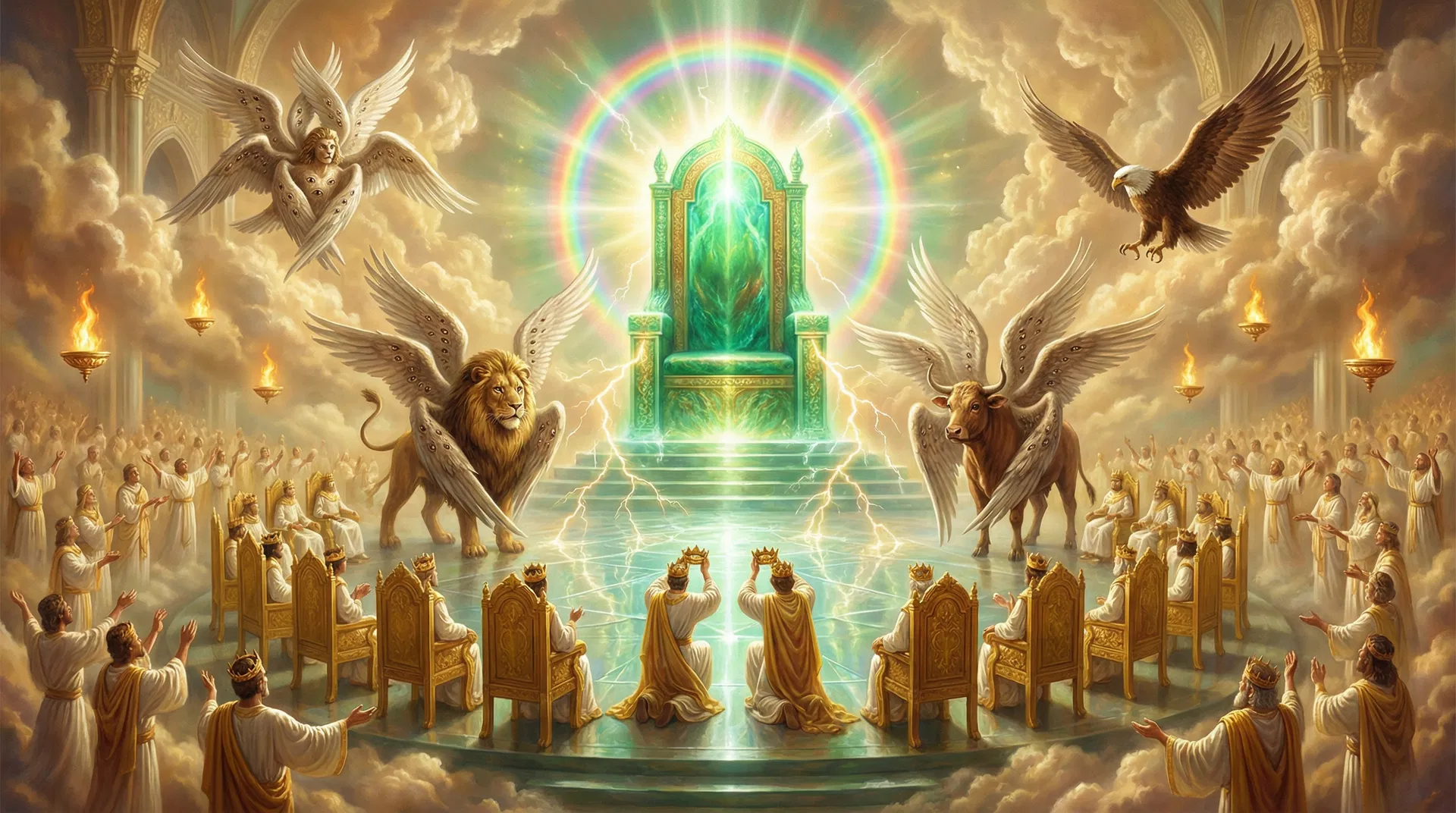
"And there was a rainbow around the throne, in appearance like an emerald."
The rainbow is one of the most theologically rich symbols in the entire passage. Its first appearance in Scripture is in Genesis 9:11–17, where God places a rainbow in the sky as a sign of His covenant with Noah — a promise never again to destroy the earth by flood. In the midst of the most fearful vision of divine sovereignty and coming judgment in all of Scripture, the throne of God is encircled by this covenant sign.
The colour is significant: not the multicoloured arc of a natural rainbow, but a single emerald green — the colour of life and renewal. This is not merely a decorative detail. It is a theological statement: the God who judges is also the God who keeps covenant. His sovereignty is never exercised in violation of His promises. As Charles Spurgeon wrote of this rainbow: "As a sovereign, He might cast you away, but He has promised that He never will, and never will He."
The Twenty-Four Elders (v. 4)
"Around the throne were twenty-four thrones, and on the thrones I saw twenty-four elders sitting, clothed in white robes; and they had crowns of gold on their heads."
The identity of the twenty-four elders is one of the most debated questions in Revelation scholarship. The number twenty-four has been interpreted in several ways. The most widely accepted scholarly view is that it combines the twelve tribes of Israel (representing the Old Testament people of God) with the twelve apostles (representing the New Testament church), forming a complete symbolic representation of the redeemed people of God throughout all ages.
This interpretation is supported by Revelation 21:12–14, where the New Jerusalem has twelve gates inscribed with the names of the twelve tribes and twelve foundations inscribed with the names of the twelve apostles. The twenty-four elders, on this reading, are the glorified representatives of the entire covenant community — the church triumphant, already enthroned in heaven.
An alternative view, championed by scholars such as David Aune, identifies the elders as angelic beings modelled on the divine council imagery of the Old Testament (cf. Psalm 82:1; Job 1:6). The twenty-four priestly courses established by David in 1 Chronicles 24 provide another possible background, suggesting a heavenly priestly order.
What is beyond dispute is the significance of their posture and attire. They are seated — a posture of authority and rest. They wear white robes — the garments of righteousness and victory. They wear crowns (stephanos — the victor's crown, not the royal diadema) — indicating that they have already received their reward. They are not waiting for vindication; they have received it.
Lightning, Thunder, and Voices (v. 5a)
"And from the throne proceeded lightnings, thunderings, and voices."
This triad — lightning, thunder, voices — appears three more times in Revelation (8:5; 11:19; 16:18), each time associated with a major act of divine judgment. The imagery is drawn directly from the theophany at Sinai, where God descended upon the mountain in fire, smoke, and thunder (Exodus 19:16–19). The people of Israel trembled and could not approach. The same awesome power that terrified Israel at Sinai now proceeds from the heavenly throne, signalling that the judgments about to unfold in Revelation are not arbitrary acts of violence but the holy wrath of the covenant God.
The Seven Lamps of Fire — The Seven Spirits of God (v. 5b)
"Seven lamps of fire were burning before the throne, which are the seven Spirits of God."
The "seven Spirits of God" is a phrase that appears four times in Revelation (1:4; 3:1; 4:5; 5:6) and is widely understood as a symbolic reference to the Holy Spirit in His fullness and perfection. The number seven in Revelation consistently represents completeness and divine perfection. The background is Isaiah 11:2, which describes the Spirit of the Lord as sevenfold: the Spirit of wisdom and understanding, counsel and might, knowledge and the fear of the Lord.
The image of burning lamps before the throne recalls the seven-branched menorah in the Tabernacle (Exodus 25:31–40), which was itself a symbol of the divine presence. The Holy Spirit, here portrayed as blazing torches, is not a passive observer of the heavenly scene; He is the active agent of God's purposes, the One who carries out the divine will in the earth.
The Sea of Glass (v. 6a)
"Before the throne there was a sea of glass, like crystal."
The sea of glass is one of the most evocative images in the passage and one of the most difficult to interpret definitively. Its most obvious Old Testament parallel is the bronze laver in the Tabernacle courtyard (Exodus 30:17–21), used by the priests for ritual washing before approaching the altar. On this reading, the sea of glass represents the perfect purity and holiness required to enter God's presence — a purity that, in the heavenly realm, is already accomplished and crystallized.
Other scholars have noted the connection with the "waters above the firmament" in Genesis 1:7 and the "sea" beneath God's throne in Ezekiel 1:22–26. The sea of glass may thus represent the cosmic order — the boundary between the divine realm and the created order — now rendered perfectly transparent and still, in contrast to the turbulent, chaotic seas of the earth. In the new creation (Revelation 21:1), "there was no more sea" — the barrier between God and His people is finally and completely removed.
The Four Living Creatures (vv. 6b–8a)
The four living creatures are among the most theologically rich and visually striking elements of the entire vision. Their closest Old Testament parallels are the cherubim of Ezekiel 1 and 10 and the seraphim of Isaiah 6. In Ezekiel's vision, the four creatures each had four faces — lion, ox, man, and eagle — and four wings. In Isaiah's vision, the seraphim had six wings and cried "Holy, holy, holy." John's creatures combine both traditions: they have the four faces of Ezekiel's cherubim and the six wings and trisagion of Isaiah's seraphim.
The four faces have generated an enormous body of interpretation. The most enduring tradition, traceable to Irenaeus of Lyon (c. AD 180), associates the four faces with the four Gospels: the lion with Matthew (Jesus as the Lion of Judah), the ox with Mark (Jesus as the suffering servant), the man with Luke (Jesus as the perfect human), and the eagle with John (Jesus as the one who came from above). This interpretation, though not exegetically certain, has profoundly shaped Christian iconography and architecture for two millennia.
A more ecologically grounded interpretation sees the four creatures as representing the totality of animate creation in its highest expressions: the lion as the noblest of wild animals, the ox as the strongest of domesticated animals, the man as the pinnacle of rational creation, and the eagle as the king of birds. On this reading, the four living creatures represent all of creation gathered before the throne in perpetual worship — a foretaste of the cosmic renewal described in Romans 8:19–22.
The multitude of eyes — covering their bodies, their wings, and even within — speaks of perfect knowledge and perception. These are not blind instruments of divine power; they are beings of supreme intelligence who understand what they worship. Their ceaseless worship is not mechanical repetition but the overflow of infinite comprehension.
The Trisagion — "Holy, Holy, Holy" (v. 8b)
"And they do not rest day or night, saying: 'Holy, holy, holy, Lord God Almighty, Who was and is and is to come!'"
The trisagion — the threefold declaration of God's holiness — is the oldest and most universal act of worship in the biblical tradition. It first appears in Isaiah 6:3, where the seraphim cry it before the throne of God in the year of King Uzziah's death. In Hebrew literary convention, repetition intensifies meaning: "holy" means set apart; "holy, holy" is emphatic; "holy, holy, holy" is the superlative — the absolute, infinite, incomparable holiness of God.
The title "Lord God Almighty" translates the Greek Kyrios ho Theos ho Pantokrator — literally, "the Lord God, the One who holds all things in His hand." This is the divine name that stands in direct contrast to the Roman imperial title Dominus et Deus. The phrase "Who was and is and is to come" is an expansion of the divine name Yahweh — the eternal "I AM" of Exodus 3:14 — affirming that God's existence transcends all temporal categories.
Section 4: Old Testament Connections — The Vision in Its Biblical Context
Revelation 4 does not emerge in a vacuum. It is saturated with the imagery and theology of the Old Testament, particularly the great throne visions of the Hebrew prophets. Understanding these connections is essential to grasping what John is communicating.
Ezekiel 1 — The Chariot Throne (Merkavah): The most direct Old Testament parallel to Revelation 4 is Ezekiel's inaugural vision in Ezekiel 1. The prophet, exiled in Babylon beside the river Chebar, sees a great storm cloud approaching from the north, within which are four living creatures with four faces each (lion, ox, man, eagle), accompanied by wheels within wheels and a crystalline expanse above them. Above the expanse is a throne of sapphire, and upon the throne is a figure of blazing fire and light — the glory of God. The parallels with Revelation 4 are unmistakable: the four living creatures, the crystalline expanse (sea of glass), the throne, and the overwhelming radiance of the divine presence. John is consciously drawing on Ezekiel's vision, but he transforms it: where Ezekiel's vision was a mobile throne-chariot coming to meet the exiles in Babylon, John's vision is a fixed, eternal throne at the centre of the cosmos.
Isaiah 6 — The Seraphim and the Trisagion: Isaiah's vision in the Temple (Isaiah 6:1–8) provides the direct background for the four living creatures' worship in Revelation 4:8. The seraphim of Isaiah 6 have six wings, cover their faces and feet in the divine presence, and cry "Holy, holy, holy is the Lord of hosts; the whole earth is full of His glory." John's four living creatures have six wings and cry the same trisagion, but with the addition of the eschatological title "Who was and is and is to come." The continuity between Isaiah's vision and John's is deliberate: the God who filled the Temple with His glory in Isaiah's day is the same God who fills the heavenly throne room in John's vision.
Daniel 7 — The Ancient of Days and the Divine Council: Daniel 7:9–14 provides the background for the throne imagery and the twenty-four elders. In Daniel's vision, "thrones were set in place, and the Ancient of Days took His seat." His clothing was "white as snow" and His throne was "flaming with fire." Thousands upon thousands attended Him. The parallels with Revelation 4 are striking: the white garments, the multiple thrones, the vast heavenly assembly. Daniel's vision also introduces the "Son of Man" who approaches the Ancient of Days and receives dominion — a vision that finds its fulfilment in Revelation 5, where the Lamb approaches the throne and takes the scroll.
Section 5: The Four Living Creatures — Theological Interpretations
The four living creatures (zōa in Greek — "living beings," not "beasts" as in the KJV) have generated more interpretive discussion than almost any other element in Revelation 4. The major interpretive traditions can be organized as follows:
| Interpretation | Description | Key Proponents |
|---|---|---|
| Representatives of all creation | Lion (wild animals), ox (domesticated), man (humanity), eagle (birds) — all creation worships | Irenaeus, Clarke, Derek Thomas |
| Divine attributes | Lion (majesty), ox (strength), man (intelligence), eagle (swiftness/omniscience) | Various patristic writers |
| Four Gospel symbols | Lion (Matthew), ox (Mark), man (Luke), eagle (John) | Irenaeus, Jerome, Augustine |
| Tribal banners of Israel | Judah (lion), Ephraim (ox), Reuben (man), Dan (eagle) — from Numbers 2 | Talmudic tradition, Seiss, Mede |
| Cherubim of Ezekiel | Direct identification with the cherubim of Ezekiel 1 and 10 | Majority of modern scholars |
| Angelic guardians of the throne | Highest order of angelic beings surrounding the divine presence | Aune, Mounce |
The most exegetically defensible interpretation combines the last two: the four living creatures are cherubim — the highest order of angelic beings who guard and surround the divine throne — and their four faces represent the totality of animate creation, symbolically gathered before God in worship. This reading honours both the Old Testament background (Ezekiel 1:10; 10:14) and the cosmic scope of the worship scene.
Section 6: The Twenty-Four Elders — Scholarly Perspectives
The identity of the twenty-four elders (presbyteroi) is one of the most contested questions in Revelation scholarship. The major positions are as follows:
The Redeemed Church: The most widely held evangelical interpretation identifies the twenty-four elders as glorified human beings representing the complete people of God — twelve tribes of Israel plus twelve apostles. This view is supported by their white robes (Revelation 6:11; 7:9), their stephanos crowns (1 Corinthians 9:25; 2 Timothy 4:8), and their song in Revelation 5:9–10, where they sing "You have redeemed us to God by Your blood." The number twenty-four also echoes the twenty-four courses of the Levitical priesthood established by David (1 Chronicles 24), suggesting a royal-priestly identity consistent with 1 Peter 2:9.
Angelic Beings: David Aune and other scholars argue that the elders are angelic beings, pointing to a variant reading in Revelation 5:9 where the Greek text may not include "us" — meaning the elders may be singing about the redeemed rather than as the redeemed. On this view, the elders are members of the heavenly court, analogous to the "sons of God" (bene elohim) of the Old Testament divine council (Job 1:6; Psalm 82:1).
Heavenly Priestly Order: Some scholars see the twenty-four elders as a heavenly priestly college, modelled on the twenty-four divisions of the Levitical priesthood, serving before the divine throne in an eternal liturgical role. This interpretation emphasises their priestly functions — offering incense (Revelation 5:8) and falling prostrate in worship.
What unites all interpretations is the significance of their act of worship in Revelation 4:10–11: they cast their crowns before the throne. In the Roman Empire, this gesture had a specific meaning: vassal kings would lay their crowns before the emperor as an act of submission, acknowledging that their authority derived from him. The twenty-four elders perform this act before the heavenly throne, declaring that all authority, all achievement, all glory belongs ultimately to the Creator.
Section 7: The Heavenly Worship Scene — A Counter-Imperial Theology
The climactic act of Revelation 4 is the worship declaration of the twenty-four elders:
"You are worthy, O Lord, to receive glory and honour and power; for You created all things, and by Your will they exist and were created." (Revelation 4:11)
Every word of this declaration is charged with political and theological significance. The Greek word axios — "worthy" — was used in Roman imperial contexts to acclaim the emperor. When a Roman general returned from victory, crowds would cry axios — "he is worthy!" The same word is used here, but directed not toward Caesar but toward the Creator of the universe.
The title "Lord" (Kyrios) was the Greek equivalent of the Latin Dominus — the title Domitian demanded for himself. By applying it to God, the elders are making an explicit counter-claim: the true Dominus is not in Rome; He is on the heavenly throne.
The basis for God's worthiness is His role as Creator: "for You created all things, and by Your will they exist and were created." This is a profound theological statement. God's right to receive worship is not based on conquest, political power, or military might — the basis of Roman imperial authority. It is based on the ontological fact that He is the source of all existence. Everything that is owes its being to His creative will. This cannot be said of any emperor, any political system, or any human institution.
The phrase "by Your will they exist and were created" is particularly striking. The Greek reads dia to thelēma sou ēsan kai ektisthēsan — "because of Your will they were and were created." Existence itself is an act of divine pleasure and purpose. The universe was not created by accident, by necessity, or by conflict (as in the Babylonian Enuma Elish); it was created by the sovereign, joyful will of a personal God.
Section 8: The Symbolism of the Throne — Divine Authority and Cosmic Order
The throne (thronos) appears forty-seven times in the Book of Revelation — more than in any other book of the Bible. This extraordinary concentration is not accidental. The throne is the governing symbol of the entire book, the lens through which all other events must be interpreted.
In the ancient world, the throne was the supreme symbol of authority, sovereignty, and the right to judge. Every throne room in the ancient Near East — from the palace of Pharaoh to the court of the Persian king to the Roman imperial palace — was designed to communicate the absolute power of the one who sat upon it. Approaching a throne was an act of submission; receiving a command from a throne was an act of divine obligation.
John's vision of the heavenly throne makes several theological claims simultaneously:
Divine Authority: The throne declares that God is not merely powerful but legitimately sovereign. His authority is not usurped or contested; it is inherent in His nature as Creator. The universe is not a democracy, a republic, or an anarchy; it is a kingdom with a throne at its centre.
Cosmic Order: The arrangement of the throne room — the four living creatures at the centre, the twenty-four elders surrounding them, the sea of glass before the throne, the seven lamps burning — reflects a cosmic order that is both beautiful and purposeful. Heaven is not chaotic; it is ordered around the worship of God.
Sovereignty Over History: The throne is the source from which all the judgments of Revelation proceed. The sealed scroll of Revelation 5, the seven seals, the seven trumpets, the seven bowls — all of these are opened or poured out in response to the will of the One who sits on the throne. History is not a random sequence of events; it is the unfolding of a divine plan, administered from the throne.
The Throne and the Lamb: In Revelation 5, the Lamb (Christ) takes His place at the centre of the throne (5:6). The throne of God and the throne of the Lamb are ultimately one (Revelation 22:1, 3). This is the most profound theological statement in the book: the crucified and risen Jesus shares the divine throne, receiving the same worship as the Father. The sovereignty of God is the sovereignty of the crucified Lamb.
Section 9: Perspectives from Major Theologians
The throne room vision of Revelation 4 has been interpreted across every major era of Christian theology. The following table summarises key perspectives:
| Tradition | Scholar | Key Emphasis |
|---|---|---|
| Early Church | Irenaeus of Lyon (c. 180) | Four creatures = four Gospels; throne vision affirms divine sovereignty against Gnostic dualism |
| Early Church | Origen of Alexandria (c. 230) | Allegorical reading; throne room represents the spiritual ascent of the soul toward God |
| Medieval | Thomas Aquinas (c. 1270) | Throne imagery confirms divine simplicity and immutability; God's essence is His throne |
| Reformation | John Calvin (c. 1560) | Throne vision establishes God's absolute sovereignty; all earthly power is derivative and accountable |
| Reformation | Martin Luther (c. 1530) | Throne room as the source of the Gospel; Christ's worthiness (Rev. 5) is the answer to human unworthiness |
| Modern | G.K. Beale (1999) | Counter-imperial theology; throne vision is a deliberate challenge to Roman imperial claims |
| Modern | Richard Bauckham (1993) | Throne room as the "divine identity" — God's unique sovereignty expressed through creation and redemption |
| Modern | N.T. Wright (2011) | Throne vision as inaugurated eschatology; heaven's reality is breaking into earth's present |
Where interpreters agree: the throne room vision establishes God's absolute sovereignty, the centrality of worship, and the ultimate accountability of all earthly power to the divine throne. Where they differ: the identity of the twenty-four elders, the precise nature of the four living creatures, and the degree to which the vision is to be read literally versus symbolically.
Section 10: The Theological Message — What the Vision Means for Believers
The throne room vision of Revelation 4 carries a message that is as urgent today as it was for the persecuted Christians of first-century Asia Minor. Four theological affirmations stand at its heart:
God Reigns Above All Earthly Powers. The most immediate message of the vision is that no earthly power — however great, however cruel, however seemingly invincible — occupies the ultimate throne. Domitian's throne in Rome was a temporary seat of borrowed authority. The throne John sees in heaven is eternal, unshakeable, and surrounded by the worship of the highest beings in creation. For Christians facing persecution, this is not a consolation prize; it is the fundamental truth that makes endurance possible.
Heaven Is Centred on Worship. The activity of heaven, as Revelation 4 describes it, is worship. The four living creatures do not rest day or night. The twenty-four elders fall prostrate before the throne. The entire heavenly assembly is oriented toward the One who sits on the throne. This is not a peripheral activity of heaven; it is heaven's central occupation. The implication for earthly worship is profound: when the church gathers to worship, it is not performing a human ritual; it is joining a cosmic liturgy that never ceases.
Creation Exists for God's Glory. The worship declaration of Revelation 4:11 — "for You created all things, and by Your will they exist and were created" — establishes the purpose of existence itself. Everything that is, is because God willed it into being for His own glory and pleasure. This is not a diminishment of creation; it is its highest dignity. To exist for the glory of God is to participate in the greatest purpose in the universe.
Divine Authority Precedes and Governs All Events. Revelation 4 comes before the opening of the seals in Revelation 6. This is structurally deliberate. Before the reader witnesses a single judgment, a single trumpet blast, or a single bowl of wrath, they must first see the throne. Every subsequent event in Revelation — however terrifying — proceeds from the sovereign will of the One who is surrounded by a covenant rainbow and whose throne is encircled by the worship of the highest beings in creation. The judgments of God are not acts of cosmic rage; they are the holy, purposeful acts of the One who holds all things in His hands.
Section 11: Documentary Closing Reflection — The Foundation of Everything
We return, at the end, to where we began: the island of Patmos, the elderly apostle, the door standing open in heaven.
John could not have known, as he received this vision, how many centuries of Christian history would be shaped by what he saw. He could not have known that the trisagion — "Holy, holy, holy" — would become the centrepiece of Christian liturgy in every tradition, from the ancient Coptic church to the medieval Latin Mass to the modern charismatic worship service. He could not have known that the image of the twenty-four elders casting their crowns before the throne would inspire some of the greatest music ever composed — from Handel's Messiah to Reginald Heber's "Holy, Holy, Holy" to the countless worship songs of the contemporary church.
But he did know this: that the throne he saw was real. That the One who sat upon it was worthy. And that everything — every judgment, every redemption, every act of cosmic history — proceeded from that throne and would ultimately return to it in praise.
Revelation 4 is not merely the introduction to a book of prophecy. It is the foundation of a theology of history. It declares that history has a centre, a source, and a destination. The centre is the throne of God. The source is the creative will of the One who sits upon it. The destination is the worship of every creature in heaven and on earth and under the earth (Revelation 5:13).
For the persecuted Christian of the first century, this vision was survival. For the struggling church of every century, it is orientation. For the worshipper who gathers on any given Sunday, it is an invitation to join the song that never ends.
The door is still standing open. The throne is still occupied. And the living creatures still do not rest, day or night, saying:
"Holy, holy, holy, Lord God Almighty, Who was and is and is to come!"
References
- Beale, G.K. The Book of Revelation: A Commentary on the Greek Text. NIGTC. Grand Rapids: Eerdmans, 1999.
- Bauckham, Richard. The Theology of the Book of Revelation. Cambridge: Cambridge University Press, 1993.
- Aune, David E. Revelation 1–5. Word Biblical Commentary. Dallas: Word, 1997.
- Thomas, Derek. "A Glimpse at the Worship of Heaven: Revelation 4:1–5:14." Third Millennium Ministries, 2020.
- Levy, David M. "God's Throne Revealed: Revelation 4:1–11." Israel My Glory, August/September 1995.
- Guzik, David. Enduring Word Bible Commentary: Revelation 4.
- Wright, N.T. Revelation for Everyone. Louisville: Westminster John Knox, 2011.
- Calvin, John. Commentaries on the Book of Revelation. Edinburgh: Calvin Translation Society, 1849.