
United Kingdom: David Becomes King of All Israel
After years of patient waiting, all Israel acknowledged David as their king. The unification of the kingdom under David's rule was a spiritual milestone that foreshadowed the eternal kingdom of Jesus Christ and demonstrated the power of godly leadership to bring diverse groups together.
United Kingdom: David Becomes King of All Israel
Series: Life of David
Part: 8 of 18
Category: 2 Samuel
Introduction
After seven and a half years of patient waiting and divided rule, the moment finally arrived when all Israel would acknowledge David as their king. The path to this unified kingdom came not through David's military conquest or political maneuvering, but through the providential working of God in the hearts of the people and the dramatic events that removed the obstacles to David's full reign. The transition from a divided nation to a united kingdom under David's rule represents one of the most significant moments in Israel's history and establishes the pattern for the messianic kingdom that would one day come through David's greater Son.
The story of how David became king over all Israel reveals profound truths about God's sovereignty, the importance of unity among God's people, and the characteristics of leadership that can bring diverse groups together under a common vision. David's response to this momentous transition demonstrates the humility, wisdom, and spiritual depth that made him "a man after God's own heart" and the standard by which all subsequent kings of Israel would be measured.
The Death of Ish-Bosheth
The house of Saul's grip on the northern tribes began to crumble through a series of events that revealed the weakness and illegitimacy of Ish-Bosheth's reign. The turning point came when Abner, the real power behind Ish-Bosheth's throne, had a falling out with the puppet king over a matter involving one of Saul's concubines. This seemingly personal dispute had profound political implications, as taking a king's concubine was often seen as a claim to the throne itself.
Abner's angry response to Ish-Bosheth's accusation revealed the true nature of their relationship: "Am I a dog's head—on Judah's side? This very day I am loyal to the house of your father Saul and to his family and friends. I haven't handed you over to David. Yet now you accuse me of an offense involving this woman! May God deal with Abner, be it ever so severely, if I do not do for David what the Lord promised him on oath and transfer the kingdom from the house of Saul and establish David's throne over Israel and Judah from Dan to Beersheba" (2 Samuel 3:8-10).
This outburst is remarkable for several reasons. First, it shows that Abner had known all along that David was God's chosen king. His support of Ish-Bosheth had been motivated by personal loyalty to Saul's family and perhaps by his own desire to maintain power, not by any conviction that Ish-Bosheth was God's anointed. Second, it demonstrates how quickly political alliances can shift when they are based on personal interest rather than principle. Third, it reveals that even those who oppose God's purposes are ultimately aware of His will, even if they choose to resist it for a time.
Abner immediately began negotiations with David to bring the northern tribes under his rule. He sent messengers to David saying, "Whose land is it? Make an agreement with me, and I will help you bring all Israel over to you" (2 Samuel 3:12). David's response was shrewd and principled. He agreed to make a covenant with Abner, but on one condition: "I will make an agreement with you. But I demand one thing of you: Do not come into my presence unless you bring Michal daughter of Saul when you come to see me" (2 Samuel 3:13).
David's insistence on the return of Michal, his first wife and Saul's daughter, was both personal and political. Personally, Michal had been taken from him and given to another man during his years as a fugitive. Politically, his marriage to Saul's daughter strengthened his claim to the throne and demonstrated continuity between Saul's house and his own. The fact that Michal was taken from her current husband Paltiel, who wept as he followed her until Abner sent him back, reminds us of the human cost of political arrangements in the ancient world.
Abner then went to the elders of Israel and made his case for David: "For some time you have wanted to make David your king. Now do it! For the Lord promised David, 'By my servant David I will rescue my people Israel from the hand of the Philistines and from the hand of all their enemies'" (2 Samuel 3:17-18). This speech reveals that there had been a growing sentiment among the northern tribes that David should be their king. Abner was not imposing an unwanted ruler on reluctant subjects; he was giving voice to what many had already been thinking.
However, Abner's plan to deliver Israel to David was cut short by a personal vendetta. Joab, David's military commander, had never forgiven Abner for killing his brother Asahel in battle. When Abner came to Hebron to finalize the agreement with David, Joab lured him aside under the pretense of a private conversation and murdered him in cold blood, avenging his brother's death.
David's response to Abner's murder was immediate and emphatic. He publicly declared his innocence: "I and my kingdom are forever innocent before the Lord concerning the blood of Abner son of Ner. May his blood fall on the head of Joab and on his whole family!" (2 Samuel 3:28-29). David ordered a state funeral for Abner, commanded Joab and all the people to mourn, and personally composed a lament for the fallen commander. This public display of grief and honor for Abner served multiple purposes: it distanced David from the murder, it honored a man who had been moving toward reconciliation, and it demonstrated to the northern tribes that David valued peace and justice over personal advantage.
The death of Ish-Bosheth followed soon after. Two of his own commanders, hoping to gain favor with David, assassinated Ish-Bosheth as he slept and brought his head to David in Hebron. They expected to be rewarded for removing David's rival, but they had completely misunderstood David's character. David's response was fierce: "When wicked men have killed an innocent man in his own house and on his own bed, should I not now demand his blood from your hand and rid the earth of you?" (2 Samuel 4:11). David had the assassins executed and gave Ish-Bosheth an honorable burial in Abner's tomb.
These events demonstrate David's consistent refusal to gain the throne through violence or treachery. Even when others acted to remove obstacles to his kingship, David condemned their actions and honored those who had opposed him. This pattern of behavior was not merely political calculation; it flowed from David's deep conviction that God would establish his kingdom in His own way and time, and that the means by which he came to power mattered as much as the end result.
All Israel Comes to David
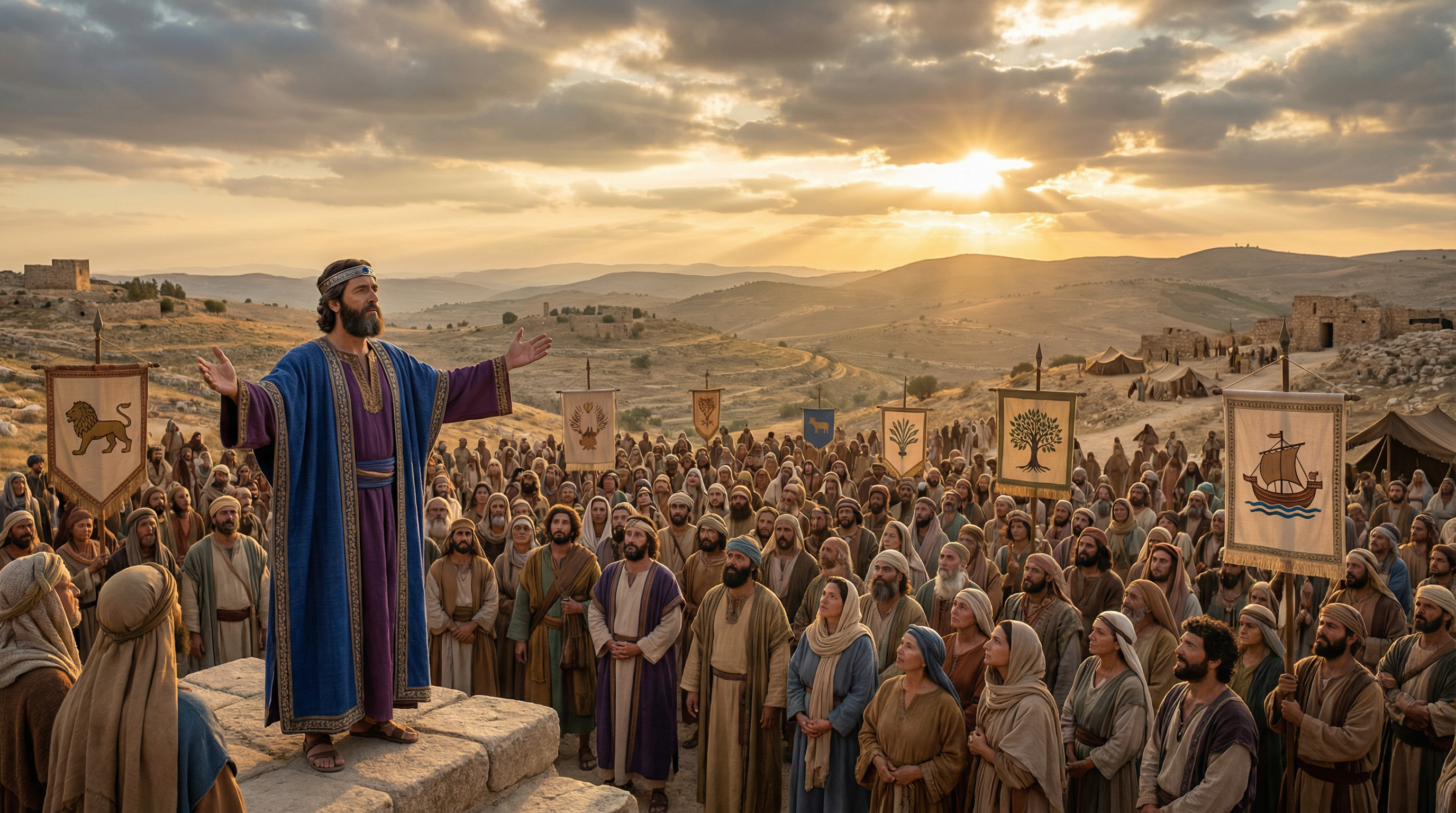
With both Abner and Ish-Bosheth dead, and with David having demonstrated his integrity in response to their deaths, the way was clear for the northern tribes to acknowledge David as king. Second Samuel 5:1-3 records the momentous event: "All the tribes of Israel came to David at Hebron and said, 'We are your own flesh and blood. In the past, while Saul was king over us, you were the one who led Israel on their military campaigns. And the Lord said to you, "You will shepherd my people Israel, and you will become their ruler."' When all the elders of Israel had come to King David at Hebron, the king made a covenant with them at Hebron before the Lord, and they anointed David king over Israel."
This passage is rich with theological and political significance. The elders' speech reveals three foundations for David's kingship over all Israel. First, there was the natural bond of kinship—"we are your own flesh and blood." David was not a foreign conqueror but a fellow Israelite, one of their own. Second, there was the practical recognition of David's proven leadership—"you were the one who led Israel on their military campaigns" even during Saul's reign. The people remembered David's victories over the Philistines and his skill as a military commander. Third, and most importantly, there was the divine appointment—"the Lord said to you, 'You will shepherd my people Israel.'" The elders acknowledged that David's kingship was not merely a political arrangement but a fulfillment of God's will.
The language of shepherding is particularly significant. God had called David from literally shepherding sheep to metaphorically shepherding His people. This imagery emphasizes the pastoral, protective, and nurturing aspects of kingship. A shepherd does not drive his flock through force but leads them, protects them from danger, seeks out the lost, and cares for their needs. This was the model of leadership that God intended for His people, and it was the model that David, at his best, embodied.
The covenant-making ceremony that followed was a solemn and sacred event. David made a covenant with the elders "before the Lord," indicating that this was not merely a political contract but a sacred commitment made in God's presence with God as witness. The covenant established mutual obligations: David would rule justly and protect the people, and the people would be loyal to David and support his reign. This covenant relationship between king and people, mediated by God's presence, was the ideal form of government for Israel.
The anointing that followed was David's third anointing. First, Samuel had anointed him privately in his father's house. Second, the men of Judah had anointed him as king over their tribe. Now, all Israel anointed him as king over the entire nation. This progression from private to tribal to national anointing reflects the gradual unfolding of God's purposes and the building of consensus and support for David's kingship.
The text notes that David was thirty years old when he became king and that he reigned for forty years—seven and a half years in Hebron over Judah and thirty-three years in Jerusalem over all Israel and Judah (2 Samuel 5:4-5). These numbers are significant. Thirty was the age at which Levites began their full service in the tabernacle, and it would later be the age at which Jesus began His public ministry. The forty-year reign echoes the forty years of Israel's wilderness wandering and Moses' time on Mount Sinai, suggesting completeness and divine ordering.
The Significance of Unity
The unification of Israel under David's rule was far more than a political achievement; it was a spiritual milestone with profound implications for God's purposes for His people. The division between Judah and the northern tribes had weakened the nation, made it vulnerable to external enemies, and hindered the fulfillment of God's promises to Abraham about possessing the land and becoming a great nation.
Unity among God's people has always been central to His purposes. Jesus would later pray for His disciples "that all of them may be one, Father, just as you are in me and I am in you" (John 17:21). The unity of Israel under David foreshadowed the spiritual unity of the church under Christ, where distinctions of tribe, nation, and background are transcended by a common allegiance to the one true King.
The basis of Israel's unity under David provides important lessons about the nature of true unity. It was not imposed by force but emerged from shared recognition of God's will. It was not based merely on political expediency but on covenant relationship. It was not superficial agreement but deep commitment to a common vision and purpose. These same principles apply to unity in the church today—it must be rooted in shared submission to Christ, expressed through covenant commitment to one another, and directed toward the common purpose of advancing God's kingdom.
The united kingdom under David also enabled Israel to reach heights of power, prosperity, and influence that would never be matched again in their history. A divided nation could barely defend itself against the Philistines; a united nation under David's leadership would expand its borders, defeat its enemies, and establish itself as a regional power. This demonstrates the practical benefits of unity—what cannot be accomplished through division and conflict becomes possible when God's people work together under godly leadership.
David's Leadership Qualities
David's successful unification of Israel and his acceptance by all the tribes reveal key qualities of effective spiritual leadership that remain relevant today. Several characteristics stand out from the biblical narrative.
First, David demonstrated patience and trust in God's timing. He did not force unity or seize power prematurely. He waited for God to remove obstacles and for the people to come to him voluntarily. This patience was rooted in faith that God would fulfill His promises in His own way and time.
Second, David showed integrity and consistency of character. His refusal to gain advantage through violence or treachery, his public mourning for Abner, his execution of Ish-Bosheth's assassins—all these actions demonstrated that David's character was consistent whether he was dealing with allies or enemies, whether circumstances favored him or not. This integrity built trust and made people willing to follow him.
Third, David exhibited wisdom in his dealings with different groups and individuals. His insistence on Michal's return, his covenant with the elders, his public honoring of Abner—each action was carefully calibrated to build support, demonstrate his legitimacy, and establish the foundation for stable rule. David understood both the spiritual and practical dimensions of leadership.
Fourth, David maintained a shepherd's heart toward the people. The elders' recognition that God had called David to "shepherd" Israel was not empty rhetoric. David genuinely cared for the welfare of the people and saw his role as serving them rather than exploiting them for his own benefit. This servant-leadership model, though countercultural in the ancient Near East, was God's design for His people and would find its ultimate expression in Jesus Christ.
Fifth, David kept God at the center of his kingship. The covenant was made "before the Lord," and David consistently sought God's guidance in his decisions. He understood that he was not an autonomous ruler but a vice-regent under God's ultimate authority. This God-centered approach to leadership is essential for anyone in positions of authority among God's people.
The Prophetic Picture
David's anointing as king over all Israel carries profound prophetic significance that points forward to Jesus Christ and His kingdom. The parallels between David's experience and Christ's are numerous and instructive.
Just as David was first recognized by a faithful remnant (Judah) before being acknowledged by all Israel, so Jesus was first recognized by a faithful remnant of Jews who became His disciples, and the day is coming when "every knee will bow" and acknowledge Him as Lord (Philippians 2:10-11). The gradual expansion of recognition from a few to many to all reflects the progressive revelation and acceptance of God's chosen King.
Just as David's kingship brought unity to a divided nation, so Christ's kingship brings unity to a divided humanity. Paul writes that in Christ "there is neither Jew nor Gentile, neither slave nor free, nor is there male and female, for you are all one in Christ Jesus" (Galatians 3:28). The unity that David brought to Israel foreshadows the far greater unity that Christ brings to His church, breaking down barriers that seemed insurmountable.
Just as David's reign brought peace, prosperity, and victory over enemies, so Christ's reign brings spiritual peace with God, abundant life, and victory over sin, death, and Satan. The blessings of David's kingdom were temporal and limited; the blessings of Christ's kingdom are eternal and unlimited.
The covenant that David made with the elders of Israel before the Lord foreshadows the new covenant that Christ has established with His people through His blood. Just as David's covenant created a binding relationship between king and people, so the new covenant creates an eternal relationship between Christ and His church, with mutual commitments and obligations that flow from love rather than mere legal requirement.
The age at which David became king—thirty years—connects him typologically to Christ, who also began His public ministry at thirty. The forty years of David's reign, suggesting completeness and divine ordering, points to the eternal reign of Christ, whose kingdom will have no end.
Lessons for Today
The account of David becoming king over all Israel offers rich lessons for believers today, both individually and corporately. Several key applications emerge from this narrative.
First, we learn the importance of patience in waiting for God's promises to be fulfilled. David waited years between his anointing by Samuel and his recognition by all Israel. During that time, he remained faithful, continued to grow in character and skill, and trusted God's timing. We too must learn to wait patiently for God to fulfill His purposes in our lives, resisting the temptation to force outcomes or take shortcuts.
Second, we see the value of integrity and consistent character in leadership. David's refusal to compromise his principles, even when it might have been politically advantageous, built trust and ultimately contributed to his acceptance by all Israel. In our own spheres of influence, whether in family, church, workplace, or community, maintaining integrity and consistency of character is essential for effective leadership.
Third, we recognize the power of unity among God's people. The divided kingdom was weak and vulnerable; the united kingdom was strong and victorious. The church today faces many challenges and enemies, and our effectiveness is greatly diminished when we are divided by petty disputes, tribal loyalties, or competing visions. Pursuing genuine unity based on shared submission to Christ should be a priority for every believer.
Fourth, we understand the importance of covenant relationships. David's kingship was established through covenant, not merely through conquest or political maneuvering. Our relationships within the church should also be characterized by covenant commitment—deep, binding, mutual obligations that flow from love and are sustained by God's grace.
Fifth, we are reminded that God's purposes will ultimately prevail, regardless of human opposition or obstacles. Abner's resistance, Ish-Bosheth's rival claim, Joab's violence—none of these could prevent God from establishing David as king over all Israel. Similarly, no human opposition or spiritual resistance can ultimately thwart God's purposes for His church or for individual believers who are walking in His will.
Conclusion
David's anointing as king over all Israel marks the culmination of a journey that began years earlier in his father's house when Samuel poured oil on the head of an unknown shepherd boy. The path from that private anointing to this public coronation had been long and difficult, marked by danger, disappointment, and delay. Yet through it all, God had been at work, preparing David for kingship, building support among the people, and orchestrating circumstances to accomplish His purposes.
The united kingdom under David represents a high point in Israel's history and a foreshadowing of the eternal kingdom of Jesus Christ. The qualities that made David successful as a king—his patience, integrity, wisdom, servant-heart, and God-centeredness—are the same qualities that should characterize all who lead among God's people today.
As we reflect on this pivotal moment in David's life, we are encouraged to trust God's timing, maintain our integrity, pursue unity with other believers, honor our covenant commitments, and keep God at the center of all we do. The same God who brought David from the shepherd's field to the throne of all Israel is faithful to complete the good work He has begun in each of His children, establishing us in the purposes He has ordained for our lives and ultimately presenting us faultless before His throne with great joy.