
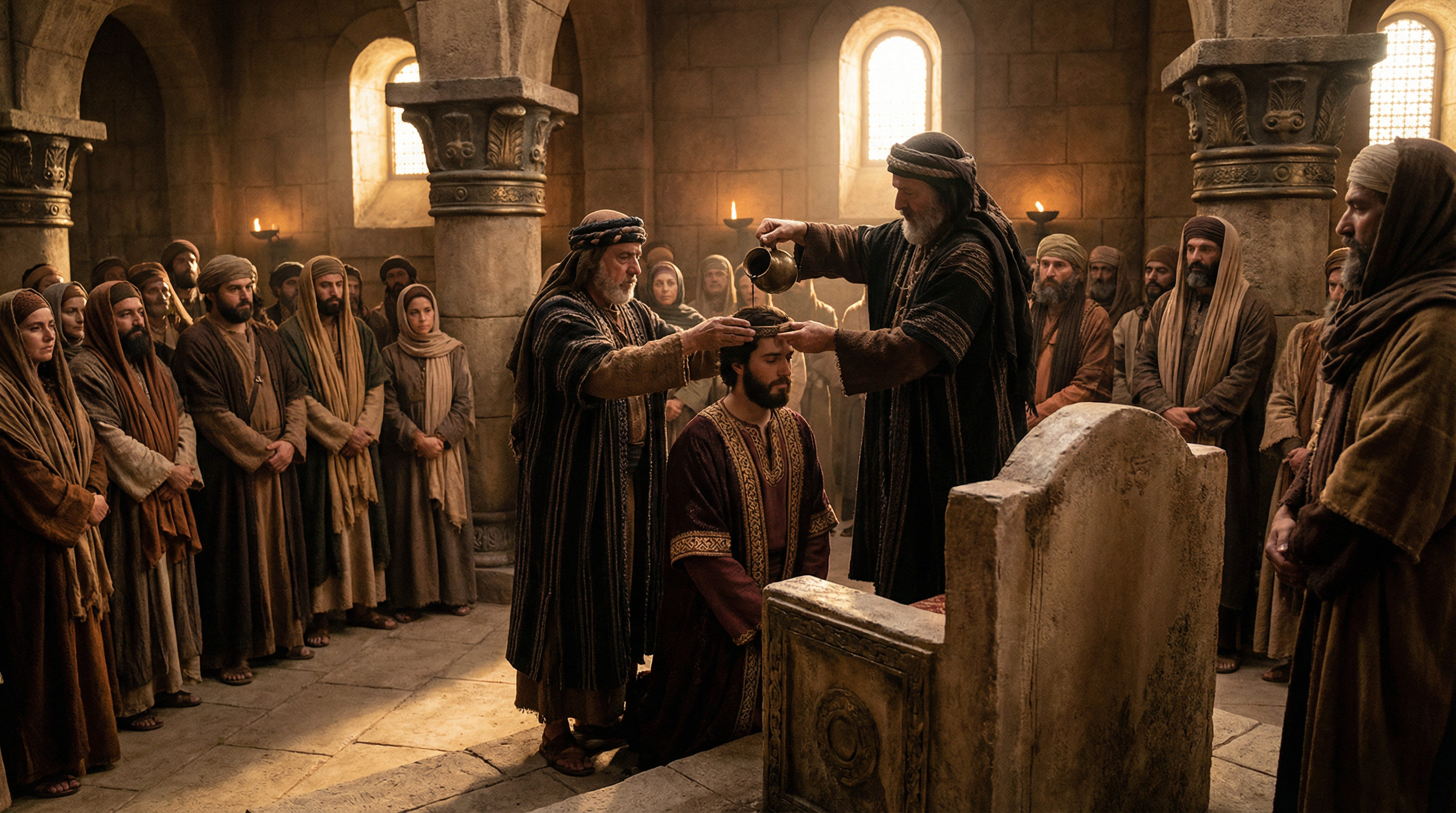
David Becomes King of Judah
After Saul's death, David sought God's direction and was anointed king over Judah in Hebron. His seven-and-a-half-year reign over Judah alone demonstrates patience in God's timing, wisdom in building a kingdom, and trust that God would complete what He had begun.
David Becomes King of Judah
Series: Life of David
Part: 7 of 18
Category: 2 Samuel
Introduction
The death of King Saul on Mount Gilboa marked the end of an era and the beginning of David's long-awaited ascent to the throne. After years of running, hiding, and waiting, the moment had finally arrived when David could claim the kingship that Samuel had anointed him for decades earlier. Yet David's path to the throne would not be straightforward or immediate. Instead of seizing power through military force or political maneuvering, David sought God's direction and moved with careful wisdom, establishing himself first as king over his own tribe of Judah while the rest of Israel remained under the rule of Saul's surviving son.
This transitional period in David's life reveals profound lessons about godly leadership, patience in God's timing, and the wisdom of building a kingdom on the foundation of genuine loyalty rather than forced submission. David's seven-and-a-half-year reign in Hebron as king of Judah alone demonstrates that God's promises, though certain, often unfold gradually and require continued faithfulness during seasons of partial fulfillment.
Seeking God's Direction
After Saul's death, David faced a critical decision. He had been anointed king over Israel, Saul was dead, and the path to the throne seemed open. Yet David did not presume to know God's will or timing. Second Samuel 2:1 records his first action: "In the course of time, David inquired of the Lord. 'Shall I go up to one of the towns of Judah?' he asked. The Lord said, 'Go up.' David asked, 'Where shall I go?' 'To Hebron,' the Lord answered."
This simple exchange reveals David's spiritual maturity and his understanding of divine guidance. Despite having been anointed king years earlier, despite having served as a successful military commander, and despite having gathered a loyal following of six hundred men, David did not move forward based on his own judgment or the apparent circumstances. He inquired of the Lord, seeking specific direction for his next step.
The method David used to inquire of the Lord was likely through the ephod and the Urim and Thummim, sacred objects used by the high priest Abiathar who had joined David's company after escaping Saul's massacre of the priests at Nob. This practice of seeking God's guidance through the priesthood was the established means of discerning God's will in the Old Testament era. David's consistent pattern of inquiry demonstrates that he understood kingship not as autonomous rule but as stewardship under God's ultimate authority.
God's answer was both affirmative and specific. David was to go up to Judah, and specifically to Hebron. This guidance was strategically wise on multiple levels. Hebron was located in the heart of Judah's territory, David's own tribe. It was a city with deep historical and spiritual significance—Abraham had lived there, and it was one of the cities of refuge. Hebron's central location and its association with the patriarchs made it an ideal place for David to establish his initial base of power.
The text notes that David took not only his two wives, Ahinoam and Abigail, but also "the men who were with him, each with his family" (2 Samuel 2:3). This detail is significant. David was not moving as a lone individual or even as a military commander with troops. He was relocating an entire community—men, women, and children—to settle in the towns around Hebron. This was not a military occupation but a peaceful settlement, establishing David's presence in Judah as a returning son rather than a conquering warlord.
Anointed King of Judah
The response of the men of Judah to David's arrival was immediate and enthusiastic: "Then the men of Judah came to Hebron, and there they anointed David king over the tribe of Judah" (2 Samuel 2:4). This was David's second anointing. The first had been private, administered by Samuel in his father's house with only his family present. This second anointing was public and political, a formal recognition by the tribal leaders of Judah that David was their chosen king.
The fact that Judah acted independently from the other tribes of Israel reflects the tribal divisions that had always existed beneath the surface of the united monarchy under Saul. Judah, the largest and most powerful of the southern tribes, had its own distinct identity and interests. David's Judahite heritage, his military exploits on behalf of the southern territories during his time as a fugitive, and his diplomatic gifts to the elders of Judah from the spoils of his victories had all prepared the way for this moment.
David's kingship over Judah was not merely a political arrangement; it was a covenant relationship. The anointing ceremony signified that David was God's chosen leader for His people, set apart and empowered by the Holy Spirit for the task of shepherding the nation. The oil poured on David's head symbolized the Spirit's presence and power, marking him as the Lord's anointed one—the mashiach or messiah of Judah.
Yet David's kingship was still incomplete. While Judah had acknowledged him, the northern tribes remained under the control of Saul's family. Abner, Saul's cousin and the commander of his army, had taken Saul's surviving son Ish-Bosheth across the Jordan to Mahanaim and proclaimed him king over the northern tribes. Israel was now divided, with two rival kings claiming authority over different portions of the nation.
This division created a precarious situation. David could have viewed Ish-Bosheth's kingship as illegitimate and immediately launched a military campaign to unite the kingdom under his rule. He had the anointing of Samuel, the support of Judah, and a battle-hardened army of loyal warriors. Yet David chose a different path—one of patience, diplomacy, and trust in God's timing.
Honoring the Faithful
One of David's first acts as king of Judah reveals his character and his political wisdom. When he learned that the men of Jabesh Gilead had risked their lives to retrieve the bodies of Saul and his sons from the Philistines and give them an honorable burial, David sent messengers to commend them: "The Lord bless you for showing this kindness to Saul your master by burying him. May the Lord now show you kindness and faithfulness, and I too will show you the same favor because you have done this. Now then, be strong and brave, for Saul your master is dead, and the people of Judah have anointed me king over them" (2 Samuel 2:5-7).
This message is masterful in its combination of genuine appreciation, spiritual blessing, and subtle political positioning. David honored the men of Jabesh Gilead for their loyalty to Saul, even though Saul had been David's enemy. He did not speak ill of the dead king or diminish the courage of those who honored him. Instead, David blessed them and invoked God's kindness upon them.
At the same time, David's message subtly introduced the reality of the new political situation. Saul was dead, and Judah had anointed David as king. The implication was clear: the men of Jabesh Gilead, who had shown such loyalty to Saul, might now consider transferring that loyalty to David, who appreciated and honored their faithfulness.
This approach reveals David's understanding of leadership and human nature. He knew that loyalty cannot be demanded or seized; it must be earned and cultivated. By honoring those who had been faithful to Saul, David demonstrated that he valued loyalty itself, not merely loyalty to himself. This would have resonated deeply with people throughout Israel who were watching to see what kind of king David would be.
The contrast between David's approach and the typical ancient Near Eastern practice is striking. When a new dynasty came to power, it was common for the new king to eliminate all potential rivals and their supporters, establishing dominance through fear and violence. David's message to Jabesh Gilead signaled that his kingship would be different—built on honor, respect, and genuine care for the people rather than on intimidation and bloodshed.
The House of Saul vs. The House of David
Despite David's gracious approach, conflict between the house of Saul and the house of David was inevitable. Abner, as the power behind Ish-Bosheth's throne, had no intention of surrendering the northern kingdom to David without a fight. The biblical narrative describes a long war between the two houses, with the house of David growing stronger while the house of Saul grew weaker (2 Samuel 3:1).
This protracted conflict was painful for David on multiple levels. He had no personal animosity toward Saul's family; indeed, he had loved Jonathan deeply and had repeatedly spared Saul's life when he had the opportunity to kill him. The civil war meant that Israelites were fighting and killing other Israelites, weakening the nation as a whole and leaving it vulnerable to external enemies like the Philistines.
Yet David understood that he could not force unity. True unity would have to come through a genuine recognition by the northern tribes that he was God's chosen king. Attempting to conquer the north through military force might have given him the throne more quickly, but it would have created lasting resentment and division. David was willing to wait for God to bring about unity in His own time and way.
The narrative in 2 Samuel 3 provides a detailed account of the political maneuvering and personal conflicts that characterized this period. The encounter between the forces of David and Ish-Bosheth at the pool of Gibeon, where twelve young men from each side engaged in a deadly contest that escalated into a broader battle, illustrates the tragic nature of civil war. The death of Asahel, brother of Joab and Abishai, at the hands of Abner created a blood feud that would have lasting consequences.
These years of conflict were not wasted time in God's economy. They served multiple purposes in David's development as a king and in the preparation of the nation for unified rule. David's restraint and patience during this period demonstrated to all Israel that he was not a power-hungry usurper but a man who trusted God to establish his kingdom. The gradual weakening of the house of Saul meant that when unity finally came, it would be clear to everyone that it was God's doing, not merely the result of David's military superiority.
Building a Kingdom
During his seven-and-a-half years in Hebron, David was not merely waiting passively for the northern tribes to acknowledge him. He was actively building the infrastructure and culture of his kingdom in Judah. The text notes that "sons were born to David in Hebron" (2 Samuel 3:2), listing six sons by different wives. This expansion of David's household was both a personal matter and a political one, as royal marriages often served to cement alliances and strengthen the king's position.
David was also developing his administration, training his military forces, establishing justice systems, and demonstrating what his kingship would look like. The people of Judah experienced firsthand David's leadership style—his accessibility, his justice, his concern for the welfare of the people, and his devotion to God. This period of limited rule allowed David to prove himself as a king on a smaller scale before taking on the responsibility of ruling all Israel.
The biblical text emphasizes that "David became more and more powerful, because the Lord God Almighty was with him" (2 Samuel 5:10, referring to the period after he became king of all Israel, but the principle applied throughout his reign). David's growing strength was not merely military or political; it was fundamentally spiritual. God's presence with David was the source of his success, and this was evident to those who observed his reign.
David's time in Hebron also allowed him to consolidate his relationship with Judah and the surrounding territories. He had already built goodwill through his actions during his fugitive years, but now as king he could formalize alliances, establish trade relationships, and create the economic and social structures that would support a stable kingdom. When the time came for him to rule all Israel, he would have a strong southern base to build upon.
Lessons from Hebron
David's experience as king of Judah in Hebron offers rich lessons for believers today about leadership, patience, and trust in God's timing. Several key principles emerge from this period of David's life.
First, David's example teaches us the importance of seeking God's direction even when the path forward seems obvious. After Saul's death, it would have been natural for David to assume that he should immediately claim the throne over all Israel. Instead, he inquired of the Lord and followed God's specific guidance to go to Hebron. This pattern of seeking God's will rather than presuming upon it is a mark of spiritual maturity that every believer should cultivate.
Second, David's patience during the years of divided kingdom demonstrates that God's promises often unfold gradually. David had been anointed king over Israel, but he spent seven and a half years ruling only Judah. This partial fulfillment of God's promise could have been frustrating, but David trusted that God would complete what He had begun. In our own lives, we often experience seasons where God's promises are partially fulfilled, and we must trust Him to bring them to completion in His perfect timing.
Third, David's gracious treatment of those who had been loyal to Saul shows the importance of honoring faithfulness even when it was directed toward our rivals or opponents. David could have condemned the men of Jabesh Gilead for their loyalty to Saul, but instead he blessed them for it. This demonstrates a secure leadership that values character and loyalty as principles, not merely as personal benefits.
Fourth, David's restraint in not forcing unity through military conquest reveals wisdom about the nature of true unity. Imposed unity is fragile and temporary; genuine unity must be built on shared conviction and mutual respect. David was willing to wait for the northern tribes to come to him voluntarily rather than compelling their submission through force. This principle applies to the church today, where unity must be based on genuine fellowship in Christ rather than organizational coercion.
Fifth, David's years in Hebron remind us that seasons of limited influence or partial success are not wasted time but opportunities for growth, development, and preparation. David used his time as king of Judah to develop his leadership skills, build his administration, and demonstrate the character of his kingship. When the opportunity came to rule all Israel, he was ready because of what he had learned and built during the Hebron years.
The Prophetic Significance
David's anointing as king of Judah carries profound prophetic significance that points forward to Jesus Christ, the ultimate Son of David. Just as David was first anointed in private by Samuel, then publicly by Judah, and finally by all Israel, so Jesus has experienced multiple stages of recognition and enthronement.
Jesus was anointed by the Holy Spirit at His baptism, marking the beginning of His public ministry. He was recognized and worshiped by a faithful remnant during His earthly life—those who, like the tribe of Judah, acknowledged Him as their King while others rejected Him. After His resurrection and ascension, He was enthroned at the right hand of the Father, ruling over His church. Yet the day is coming when every knee will bow and every tongue confess that Jesus Christ is Lord, when all nations will acknowledge His kingship just as all the tribes of Israel eventually acknowledged David.
The division between Judah and Israel during David's early reign also foreshadows the divisions that would later split the kingdom after Solomon's death, and ultimately points to the spiritual division between those who acknowledge Christ's kingship and those who reject it. Just as David patiently waited for all Israel to recognize him as king, so Christ patiently waits for the full number of His people to come to faith before He returns to establish His kingdom in its fullness.
The city of Hebron itself carries messianic significance. Its name means "association" or "alliance," and it was the place where David first established his covenant relationship with his people as their king. Similarly, Christ establishes His kingdom through covenant relationship with His people, binding Himself to them and them to Himself in an eternal alliance sealed by His blood.
Conclusion
David's seven-and-a-half years as king of Judah in Hebron represent a crucial transitional period in his journey from shepherd to king of all Israel. These years were characterized by patience, wisdom, and trust in God's timing. Rather than seizing power through force or presuming upon God's promises, David moved forward step by step, seeking God's direction and building his kingdom on foundations of justice, honor, and genuine loyalty.
The lessons from this period remain relevant for believers today. We too live in a time of partial fulfillment, waiting for the complete realization of God's promises. We too must learn to seek God's direction rather than presuming upon His will. We too must develop patience during seasons when God's purposes unfold more gradually than we might wish. And we too must build our lives and ministries on foundations of character and faithfulness rather than on shortcuts and forced outcomes.
As we reflect on David's experience in Hebron, we are reminded that God's timing is perfect, that His promises are sure, and that those who wait upon Him will never be disappointed. The same God who brought David from the shepherd's field to the throne of Judah, and ultimately to the throne of all Israel, is faithful to complete the good work He begins in each of His children. Our calling is to trust Him, seek His direction, and move forward in obedience, knowing that He will accomplish His purposes in His perfect time.