
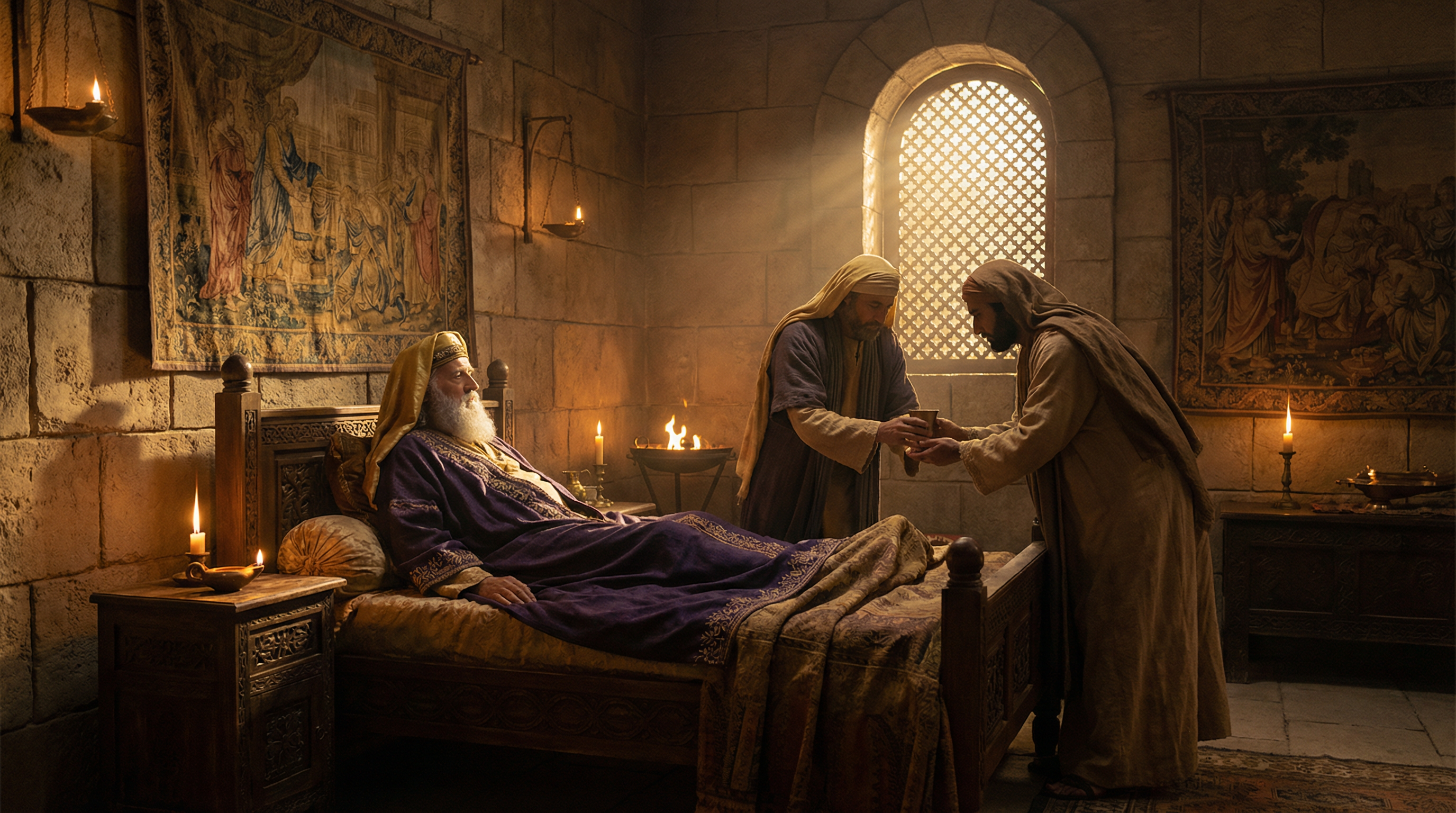
David's Final Years and Adonijah's Rebellion
The final chapters of David's life present a sobering picture of an aging king whose physical strength had faded but whose spiritual legacy remained powerful. Adonijah's attempted coup and Solomon's anointing demonstrate God's faithfulness in preserving His covenant promises despite human weakness and ambition.
David's Final Years and Adonijah's Rebellion
Series: Life of David
Part: 16 of 18
Category: 1 Kings
Introduction
The final chapters of David's life, recorded in 1 Kings 1-2, present a sobering picture of an aging king whose physical strength had faded but whose spiritual legacy remained powerful. David, who had once killed a lion and a bear with his bare hands, who had defeated Goliath and conquered nations, now struggled with the frailties of old age. Yet even in his weakness, God's purposes continued to unfold through him.
These final years were marked by political intrigue, family conflict, and the challenge of succession. David's son Adonijah attempted to seize the throne, creating a crisis that threatened to plunge the nation into civil war. The resolution of this crisis and the successful transition of power to Solomon demonstrated God's faithfulness in preserving His covenant promises despite human weakness and ambition.
Understanding David's final years helps us grasp the full scope of his life and prepares us to appreciate the wisdom and grace with which God orchestrated the succession. It also teaches us vital lessons about aging, legacy, faithfulness in weakness, and God's sovereignty in accomplishing His purposes through imperfect people.
The Aging King
First Kings opens with a stark description of David's condition: "When King David was very old, he could not keep warm even when they put covers over him" (1 Kings 1:1). This detail, seemingly mundane, actually carries profound significance. The mighty warrior who had endured years in the wilderness, who had led armies in battle, who had danced before the Ark with such vigor—this same man now shivered under blankets, unable to generate his own body heat.
David's servants sought a solution to his condition, bringing Abishag, a beautiful young woman from Shunem, to care for him and keep him warm. The text carefully notes that "the king had no sexual relations with her" (1 Kings 1:4), emphasizing David's physical decline and perhaps also his spiritual growth. The man who had once been consumed by lust for Bathsheba now showed restraint and propriety even in his weakness.
This picture of David's frailty stands in sharp contrast to the vigor and strength that had characterized most of his life. Yet it reminds us of an important truth: physical decline is the common lot of humanity. Even the greatest warriors, the most powerful kings, and the most faithful servants of God eventually face the limitations of aging bodies. David's weakness in his final years does not diminish his accomplishments or his legacy; rather, it humanizes him and reminds us that God's power is made perfect in weakness.
The description of David's condition also sets the stage for the crisis that would follow. A weak king creates a power vacuum, and ambitious men are quick to exploit such opportunities. David's physical decline made him vulnerable not only to the cold but also to political maneuvering and family intrigue.
Adonijah's Ambition
Into this situation stepped Adonijah, David's fourth son and apparently the oldest surviving son after the deaths of Amnon, Absalom, and Chileab (who is mentioned only once and presumably died young). Adonijah was "very handsome" and had been born "next after Absalom" (1 Kings 1:6). The text adds a crucial detail about David's parenting: "His father had never rebuked him by asking, 'Why do you behave as you do?'"
This statement echoes the pattern we have seen throughout David's family life. Just as he had failed to discipline Amnon after the rape of Tamar, and just as he had been slow to address Absalom's rebellion, David had apparently indulged Adonijah, never confronting his behavior or setting clear boundaries. This parental permissiveness, born perhaps from David's own guilt over his sins or from simple weakness, had created an environment where Adonijah felt entitled to seize what he wanted.
Adonijah's ambition manifested in a calculated move to claim the throne. He "got chariots and horses ready, with fifty men to run ahead of him" (1 Kings 1:5)—exactly the same display that Absalom had used when preparing his rebellion (2 Samuel 15:1). Adonijah was following his brother's playbook, creating an impressive public image and positioning himself as the heir apparent.
More significantly, Adonijah recruited powerful allies. He conferred with Joab, David's longtime military commander, and with Abiathar the priest. These were not minor figures—Joab had been David's general for decades, and Abiathar had been David's priest since the days of fleeing from Saul. Their support gave Adonijah's claim significant credibility and military backing.
The text notes, however, that several key figures did not support Adonijah: Zadok the priest, Benaiah son of Jehoiada (commander of David's personal guard), Nathan the prophet, Shimei, Rei, and David's special guard. This division among David's advisors and officials revealed a fundamental split in the kingdom's leadership.
The Conspiracy at En Rogel
Adonijah's move came to a head when he held a great feast at the Stone of Zoheleth near En Rogel, just outside Jerusalem. He invited all his brothers (except Solomon) and all the royal officials of Judah, but he deliberately excluded Nathan the prophet, Benaiah, David's special guard, and Solomon. This selective guest list revealed Adonijah's true intentions—this was not a family celebration but a coronation feast.
The sacrifice of sheep, cattle, and fattened calves, combined with the gathering of supporters, created the appearance of a legitimate succession. Adonijah was attempting to present the kingdom with a fait accompli: he would declare himself king, gather support from key officials and family members, and force David either to accept the situation or to plunge the nation into civil war.
The location of the feast is significant. En Rogel was outside Jerusalem, perhaps suggesting that Adonijah did not yet feel confident enough to make his move within the city itself. Or perhaps he wanted to keep the gathering somewhat secret from David and his loyalists until the crucial moment. Either way, the choice of location revealed both Adonijah's ambition and his caution.
The exclusion of Solomon was particularly telling. Solomon was the son of Bathsheba, born after David's sin and Nathan's confrontation. He was younger than Adonijah and had no apparent claim to the throne by birth order. Yet Adonijah's deliberate exclusion of Solomon suggested that he viewed Solomon as a threat—perhaps because he knew of David's promise to Bathsheba or because he sensed God's favor on Solomon.
Nathan's Intervention
When Nathan the prophet heard about Adonijah's feast, he immediately recognized the danger. He went to Bathsheba, Solomon's mother, and asked her a pointed question: "Have you not heard that Adonijah, the son of Haggith, has become king, and our lord David knows nothing about it?" (1 Kings 1:11). Nathan's question revealed that David had been kept in the dark about Adonijah's move—whether through deliberate deception or simply because of his isolation in old age.
Nathan then gave Bathsheba specific instructions for approaching David. She was to go to the king and remind him of his oath that Solomon would succeed him, and then to point out that Adonijah had declared himself king without David's knowledge. Nathan promised to come in while she was speaking and confirm her words.
This plan demonstrated Nathan's wisdom and his understanding of how to navigate the delicate political situation. By having Bathsheba speak first, Nathan ensured that David would hear from the mother of his chosen heir. By following immediately after, Nathan would provide prophetic confirmation and prevent any suggestion that Bathsheba was merely seeking advantage for her son.
Bathsheba followed Nathan's instructions precisely. She went to David's chamber, where Abishag was attending him, and bowed before the king. When David asked what she wanted, she reminded him of his oath: "My lord, you yourself swore to me your servant by the Lord your God: 'Solomon your son shall be king after me, and he will sit on my throne'" (1 Kings 1:17).
This oath is not recorded elsewhere in Scripture, but there is no reason to doubt its authenticity. David had made many decisions and promises that were not recorded in the biblical narrative. The fact that David did not deny the oath when Bathsheba mentioned it confirms that he had indeed promised the throne to Solomon.
Bathsheba then informed David of Adonijah's feast and his claim to the throne. She concluded with a pointed observation: "My lord the king, the eyes of all Israel are on you, to learn from you who will sit on the throne of my lord the king after him. Otherwise, as soon as my lord the king is laid to rest with his ancestors, I and my son Solomon will be treated as criminals" (1 Kings 1:20-21).
This statement revealed the stakes of the situation. If Adonijah successfully claimed the throne, he would need to eliminate potential rivals—which meant Solomon and Bathsheba would be in mortal danger. The succession crisis was not merely a political question; it was a matter of life and death.
David's Decisive Action
As Bathsheba was speaking, Nathan arrived and was announced to the king. He confirmed everything Bathsheba had said and added details about the feast and the guests. He concluded with a question that cut to the heart of the matter: "Is this something my lord the king has done without letting his servants know who should sit on the throne of my lord the king after him?" (1 Kings 1:27).
David's response was immediate and decisive. He called for Bathsheba and made a solemn oath: "As surely as the Lord lives, who has delivered me out of every trouble, I will surely carry out this very day what I swore to you by the Lord, the God of Israel: Solomon your son shall be king after me, and he will sit on my throne in my place" (1 Kings 1:29-30).
This oath demonstrated several important things. First, David was still mentally sharp despite his physical weakness. He understood the situation, recognized the danger, and acted decisively to address it. Second, David's oath invoked the Lord's name and recalled God's faithfulness in delivering him from trouble throughout his life. This was not merely a political decision but a spiritual commitment. Third, David was determined to fulfill his promise to Bathsheba and to ensure that God's purposes were accomplished.
David then gave specific instructions for Solomon's anointing. Zadok the priest, Nathan the prophet, and Benaiah son of Jehoiada were to take Solomon down to Gihon on David's own mule. There, Zadok and Nathan were to anoint Solomon as king over Israel, blow the trumpet, and proclaim, "Long live King Solomon!" They were then to bring Solomon back to sit on David's throne.
The choice of Gihon was significant. This was a spring located in the Kidron Valley, east of Jerusalem and closer to the city than En Rogel, where Adonijah was feasting. By having Solomon anointed at Gihon, David was making a public statement that would be visible to the city and would reach Adonijah's ears quickly.
The use of David's own mule was also significant. In ancient Near Eastern culture, riding the king's mule was a sign of royal authority and succession. By placing Solomon on his personal mule, David was publicly designating Solomon as his chosen heir.
Solomon's Anointing
Benaiah responded to David's instructions with enthusiasm: "Amen! May the Lord, the God of my lord the king, so declare it. As the Lord was with my lord the king, so may he be with Solomon to make his throne even greater than the throne of my lord King David!" (1 Kings 1:36-37). This blessing revealed Benaiah's faith and his recognition that the succession was not merely a human decision but a divine appointment.
Zadok, Nathan, and Benaiah carried out David's instructions precisely. They took Solomon to Gihon, where Zadok took the horn of oil from the sacred tent and anointed Solomon. They blew the trumpet, and all the people shouted, "Long live King Solomon!" The people then followed Solomon back to Jerusalem, playing pipes and rejoicing with such joy that "the ground shook with the sound" (1 Kings 1:40).
This public celebration stood in stark contrast to Adonijah's private feast. Where Adonijah had gathered a select group of supporters in secret, Solomon's anointing was a public event that involved the people of Jerusalem. Where Adonijah had excluded key figures, Solomon's anointing was conducted by the priest and the prophet with the blessing of the king. The legitimacy of Solomon's claim was beyond question.
The sound of the celebration reached Adonijah and his guests as they were finishing their feast. When Joab heard the sound of the trumpet, he asked, "What's the meaning of all the noise in the city?" (1 Kings 1:41). Even as he spoke, Jonathan son of Abiathar the priest arrived with news of Solomon's anointing.
Jonathan's report was devastating to Adonijah's cause. He described how David had sent Solomon to be anointed at Gihon, how the royal officials had blessed the new king, and how David himself had bowed in worship on his bed, saying, "Praise be to the Lord, the God of Israel, who has allowed my eyes to see a successor on my throne today" (1 Kings 1:48).
Adonijah's Fear and Solomon's Mercy
The reaction of Adonijah's guests was immediate: "At this, all Adonijah's guests rose in alarm and dispersed" (1 Kings 1:49). The feast that had seemed like a coronation celebration moments before now became a scene of panic and flight. The guests recognized that they had backed the wrong candidate and that their association with Adonijah's attempted coup could cost them dearly.
Adonijah himself was terrified. He went immediately to the sacred tent and took hold of the horns of the altar, seeking sanctuary. In ancient Israel, the altar provided a place of refuge for those who feared for their lives, based on the principle that God's presence offered protection. By grasping the horns of the altar, Adonijah was claiming this protection and acknowledging his vulnerability.
When Solomon was told that Adonijah was holding onto the horns of the altar, he also learned of Adonijah's plea: "Let King Solomon swear to me today that he will not put his servant to death with the sword" (1 Kings 1:51). Adonijah was begging for his life, recognizing that his attempted coup could be considered treason punishable by death.
Solomon's response demonstrated both wisdom and mercy. He said, "If he shows himself to be worthy, not a hair of his head will fall to the ground; but if evil is found in him, he will die" (1 Kings 1:52). Solomon was offering Adonijah a conditional pardon—he would live if he proved himself loyal, but any further rebellion would result in death.
Solomon then sent for Adonijah, who came and bowed down before him. Solomon's simple command—"Go to your home"—was both a dismissal and a warning. Adonijah was being sent away from the center of power, removed from any position where he might threaten Solomon's rule. He was alive, but his ambitions were finished.
Lessons for Today
The account of Adonijah's rebellion and Solomon's anointing offers several important lessons for believers today. First, we see the consequences of parental permissiveness. David's failure to discipline Adonijah ("His father had never rebuked him") created an environment where Adonijah felt entitled to seize power. Parents who fail to set boundaries and provide correction often raise children who lack self-control and respect for authority.
Second, we observe that God's purposes prevail despite human scheming. Adonijah had powerful allies, a plausible claim to the throne, and a well-executed plan. Yet God had chosen Solomon, and no amount of human maneuvering could thwart that divine purpose. This reminds us that God's plans cannot be frustrated by human ambition or conspiracy.
Third, we learn about the importance of decisive action in critical moments. Despite his physical weakness, David acted quickly and decisively when the succession was threatened. He did not waver or delay but immediately took steps to ensure that Solomon would be anointed. There are times when delay is dangerous, and decisive action is required.
Fourth, we see the value of wise counsel. Nathan's intervention was crucial in alerting David to the crisis and guiding the response. Bathsheba's willingness to follow Nathan's advice and approach David demonstrated humility and wisdom. Surrounding ourselves with godly counselors and being willing to heed their advice is essential for navigating difficult situations.
Fifth, we observe that mercy and justice can coexist. Solomon showed mercy to Adonijah by sparing his life, but he also made clear that future rebellion would not be tolerated. This balance between grace and accountability is important in leadership and in personal relationships.
The Greater Son of David
Ultimately, the account of Solomon's anointing points us to Jesus Christ, the ultimate Son of David. Where Adonijah tried to seize the throne through human ambition and political maneuvering, Jesus received His kingdom from the Father. Where Solomon's succession was contested and required decisive action to secure, Jesus' right to rule is uncontested and eternal.
Moreover, the anointing of Solomon with oil foreshadows the anointing of Jesus with the Holy Spirit. Solomon was anointed to be king over Israel; Jesus was anointed to be King of kings and Lord of lords. Solomon's kingdom brought peace and prosperity to Israel for a time; Jesus' kingdom brings eternal peace and righteousness to all who trust in Him.
The celebration that accompanied Solomon's anointing—so joyful that "the ground shook with the sound"—anticipates the even greater celebration that will accompany Christ's return and the full establishment of His kingdom. On that day, every knee will bow and every tongue confess that Jesus Christ is Lord, to the glory of God the Father.
Conclusion
David's final years and Adonijah's rebellion reveal both human weakness and divine faithfulness. David, once the mighty warrior, was now an old man struggling with the frailties of age. Yet God's purposes continued to unfold through him. Adonijah's ambition threatened to derail the succession, but God's chosen king, Solomon, was anointed and established on the throne.
As we reflect on this account, we are reminded that God's plans are not dependent on human strength or perfection. He accomplishes His purposes through weak and flawed people, demonstrating that His power is made perfect in weakness. We are also reminded of the importance of decisive action in critical moments, the value of wise counsel, and the need to balance mercy with justice.
Most importantly, we are pointed to Jesus Christ, the perfect King who never grasped for power but humbled Himself and became obedient to death, and who was therefore exalted to the highest place. In Him, we find the fulfillment of all God's promises to David and the hope of an eternal kingdom that will never end.