
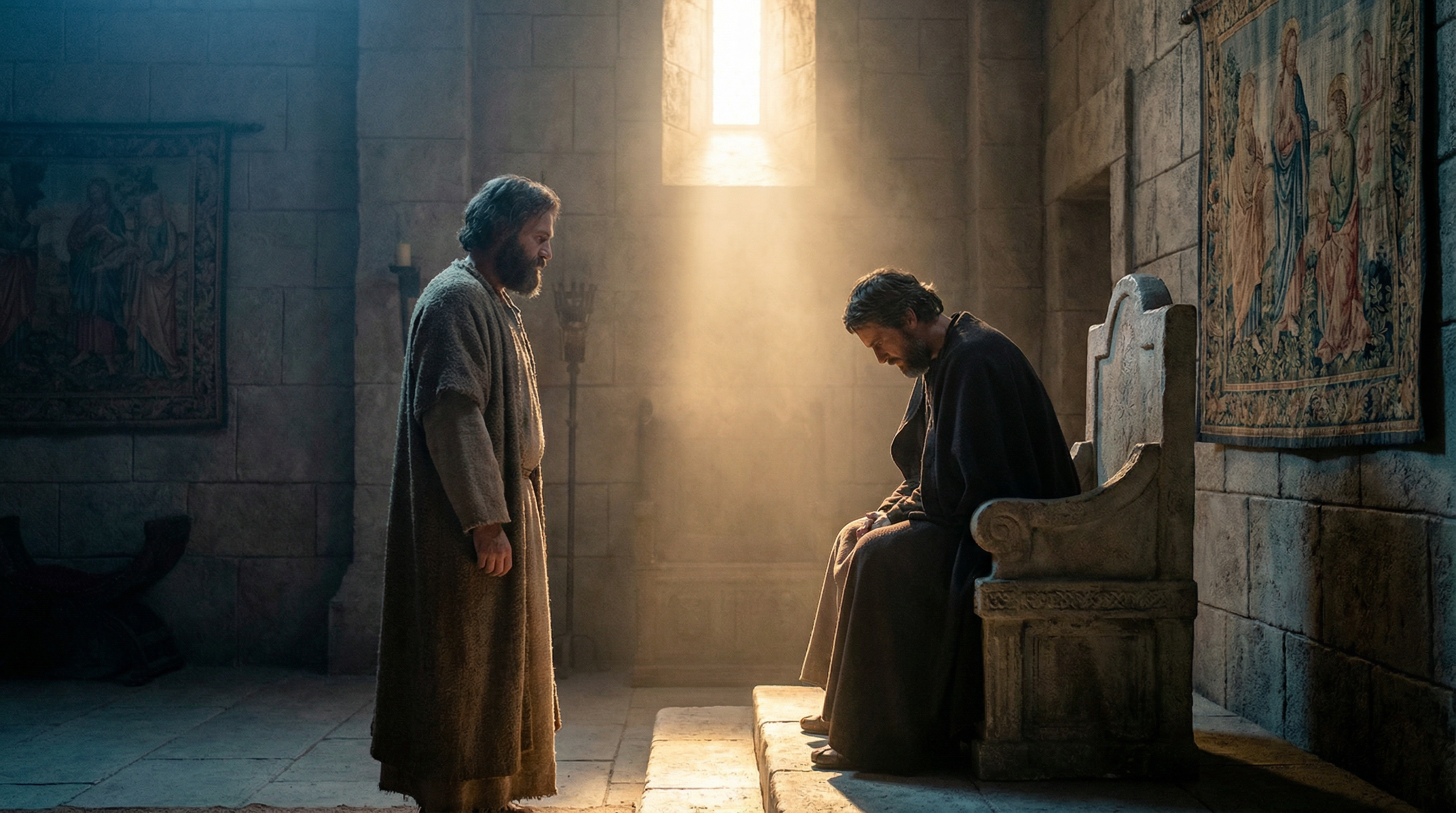
Nathan's Confrontation and David's Repentance
After David's sin with Bathsheba and the murder of Uriah, months passed with no apparent consequences. But God had not forgotten. The Lord who sees all things was about to confront David through His prophet Nathan in one of the most powerful narratives of conviction and restoration in Scripture.
Nathan's Confrontation and David's Repentance
Series: Life of David
Part: 14 of 18
Category: 2 Samuel
Introduction
After David's sin with Bathsheba and the murder of Uriah, months passed with no apparent consequences. Bathsheba mourned her husband, married David, and bore a son. To all outward appearances, David had successfully covered his tracks. His secret was safe, his reputation intact, his kingdom secure. But God had not forgotten. The Lord who sees all things and before whom nothing is hidden was about to confront David through His prophet Nathan.
The account of Nathan's confrontation and David's repentance, recorded in 2 Samuel 12 and reflected in Psalm 51, stands as one of the most powerful narratives of conviction, confession, and restoration in all of Scripture. It demonstrates God's faithfulness in confronting sin, the power of genuine repentance, and the possibility of forgiveness even after catastrophic moral failure.
This narrative teaches us vital truths about the character of God, the nature of true repentance, and the path to restoration after sin. It shows us that God loves us too much to leave us in our sin, that genuine repentance involves more than words, and that God's grace is available even to those who have fallen far. Understanding this account is essential for anyone who has experienced the weight of guilt, the pain of conviction, or the longing for restoration.
The Parable: A Story That Reveals the Heart
The Lord sent Nathan to David, and when he came to him, Nathan did not immediately accuse David of his sin. Instead, he told a story: "There were two men in a certain town, one rich and the other poor. The rich man had a very large number of sheep and cattle, but the poor man had nothing except one little ewe lamb he had bought. He raised it, and it grew up with him and his children. It shared his food, drank from his cup and even slept in his arms. It was like a daughter to him" (2 Samuel 12:1-3).
This opening immediately engaged David's attention. As a former shepherd who had cared for his father's flocks, David understood the bond between a shepherd and his sheep. The image of the poor man's lamb—his only possession, raised like a member of the family—would have resonated deeply with David's own experience and values.
Nathan continued: "Now a traveler came to the rich man, but the rich man refrained from taking one of his own sheep or cattle to prepare a meal for the traveler who had come to him. Instead, he took the ewe lamb that belonged to the poor man and prepared it for the one who had come to him" (2 Samuel 12:4).
The injustice of the story was glaring. The rich man, who had abundant flocks, took the poor man's only lamb—not out of necessity but out of selfish unwillingness to sacrifice from his own abundance. This act combined greed, cruelty, and abuse of power. The rich man had everything, yet he took the one thing that belonged to the poor man, destroying something precious for his own convenience.
David's response was immediate and passionate: "David burned with anger against the man and said to Nathan, 'As surely as the Lord lives, the man who did this must die! He must pay for that lamb four times over, because he did such a thing and had no pity'" (2 Samuel 12:5-6).
David's anger revealed his sense of justice and his compassion for the oppressed. His judgment was severe—the rich man deserved death for his crime. His demand for fourfold restitution reflected the law's requirement for theft (Exodus 22:1). David's indignation at the injustice in the parable was genuine and righteous. Yet he failed to see that he was pronouncing judgment on himself.
The Confrontation: "You Are the Man!"
Then came Nathan's devastating declaration: "You are the man!" (2 Samuel 12:7). With four words, Nathan shattered David's self-deception and forced him to see his sin for what it was. The rich man in the parable was David. The poor man was Uriah. The precious lamb was Bathsheba. And the traveler for whom the lamb was taken represented David's own lust.
Nathan continued with God's indictment, reminding David of all that God had done for him: "This is what the Lord, the God of Israel, says: 'I anointed you king over Israel, and I delivered you from the hand of Saul. I gave your master's house to you, and your master's wives into your arms. I gave you all Israel and Judah. And if all this had been too little, I would have given you even more'" (2 Samuel 12:7-8).
This recounting of God's blessings served multiple purposes. It demonstrated that David had no excuse for his sin—he lacked nothing that God had not provided. It showed that David's sin was not born of necessity but of greed and lust. And it revealed the depth of David's ingratitude—after receiving so much from God, he had despised God's word and done evil in His sight.
Then came the specific charges: "Why did you despise the word of the Lord by doing what is evil in his eyes? You struck down Uriah the Hittite with the sword and took his wife to be your own. You killed him with the sword of the Ammonites" (2 Samuel 12:9). God saw through David's cover-up. Though David had not personally wielded the sword that killed Uriah, God held him responsible for the murder. Using the Ammonites as his instrument did not absolve David of guilt.
Nathan then pronounced God's judgment: "Now, therefore, the sword will never depart from your house, because you despised me and took the wife of Uriah the Hittite to be your own" (2 Samuel 12:10). The violence that David had unleashed would return to plague his own family. The remainder of David's reign would be marked by conflict, rebellion, and bloodshed within his own household.
The judgment continued: "This is what the Lord says: 'Out of your own household I am going to bring calamity on you. Before your very eyes I will take your wives and give them to one who is close to you, and he will sleep with your wives in broad daylight. You did it in secret, but I will do this thing in broad daylight before all Israel'" (2 Samuel 12:11-12). David's secret sin would result in public shame. The adultery he committed in private would be repaid with public humiliation when his own son Absalom would sleep with David's concubines on the palace roof in full view of all Israel.
The Confession: Genuine Repentance
David's response to Nathan's confrontation was immediate and unequivocal: "I have sinned against the Lord" (2 Samuel 12:13). These six words contain no excuses, no justifications, no attempts to minimize or explain away his actions. David did not blame Bathsheba for bathing where he could see her. He did not cite the stress of kingship or the example of other ancient Near Eastern monarchs who took whatever they wanted. He did not point to his many years of faithful service to God as a reason for leniency. He simply confessed: "I have sinned against the Lord."
This confession reveals several marks of genuine repentance. First, David took full responsibility for his sin. He did not shift blame or make excuses. Second, he recognized that his sin was ultimately against God. While he had wronged Bathsheba and Uriah, his primary offense was against the Lord. Third, his confession was immediate. He did not delay, equivocate, or try to negotiate. When confronted with his sin, he acknowledged it at once.
Nathan's response brought both judgment and grace: "The Lord has taken away your sin. You are not going to die. But because by doing this you have shown utter contempt for the Lord, the son born to you will die" (2 Samuel 12:13-14). God's forgiveness was immediate and complete—David would not face the death penalty that the law prescribed for adultery and murder. Yet forgiveness did not eliminate all consequences. The child conceived in adultery would die, and the sword would not depart from David's house.
This combination of forgiveness and consequences is important to understand. God's forgiveness is real and complete—when we genuinely repent, He removes our guilt and restores our relationship with Him. But forgiveness does not necessarily remove all the natural and social consequences of our sin. David was forgiven, but he would still face the results of his actions in his family and kingdom.
Psalm 51: The Prayer of a Broken Heart
David's inner struggle and his plea for forgiveness are expressed in Psalm 51, which the superscription identifies as "A psalm of David. When the prophet Nathan came to him after David had committed adultery with Bathsheba." This psalm has become the classic expression of repentance in the Judeo-Christian tradition, giving voice to the heart cry of all who seek God's mercy after sin.
The psalm begins with an appeal to God's character: "Have mercy on me, O God, according to your unfailing love; according to your great compassion blot out my transgressions. Wash away all my iniquity and cleanse me from my sin" (Psalm 51:1-2). David did not appeal to his own righteousness or past service. He appealed to God's mercy, His unfailing love, and His compassion. He recognized that his only hope was in God's gracious character, not in any merit of his own.
David then acknowledged his sin fully: "For I know my transgressions, and my sin is always before me. Against you, you only, have I sinned and done what is evil in your sight" (Psalm 51:3-4). While David's sin had harmed Bathsheba, Uriah, and others, he recognized that sin is fundamentally an offense against God. Every sin violates God's law, dishonors His name, and grieves His heart. This understanding of sin's vertical dimension—that it is primarily against God—is essential for genuine repentance.
David acknowledged his sinful nature: "Surely I was sinful at birth, sinful from the time my mother conceived me" (Psalm 51:5). This statement is not an excuse but a recognition that his specific sins of adultery and murder flowed from a deeper problem—the sinful nature inherited from Adam. David understood that his problem was not just bad choices but a corrupted heart that needed transformation.
He then expressed his desire for inner transformation: "Surely you desire truth in the inner parts; you teach me wisdom in the inmost place. Cleanse me with hyssop, and I will be clean; wash me, and I will be whiter than snow" (Psalm 51:6-7). David wanted more than external conformity to God's law; he wanted internal purity. He longed to be clean not just in behavior but in heart and mind.
David's prayer for restoration is particularly moving: "Create in me a pure heart, O God, and renew a steadfast spirit within me. Do not cast me from your presence or take your Holy Spirit from me. Restore to me the joy of your salvation and grant me a willing spirit, to sustain me" (Psalm 51:10-12). He recognized that he could not change himself through willpower or self-improvement. He needed God to create a new heart within him, to renew his spirit, and to restore the joy of salvation that sin had stolen.
The psalm concludes with a commitment to teach others: "Then I will teach transgressors your ways, so that sinners will turn back to you" (Psalm 51:13). David understood that his experience of sin and restoration could become a testimony that would help others. His failure, painful as it was, could be used by God to warn others about the dangers of sin and to point them toward the mercy available through repentance.
The Consequences: Grace and Judgment
After Nathan left, the Lord struck the child that Uriah's wife had borne to David, and he became ill (2 Samuel 12:15). David's response to his son's illness demonstrated the sincerity of his repentance and his desperate hope in God's mercy. He pleaded with God for the child, fasted, and spent the nights lying in sackcloth on the ground (2 Samuel 12:16). His servants tried to persuade him to get up and eat, but he refused.
David's fasting and prayer were not attempts to manipulate God or to earn forgiveness through suffering. Rather, they expressed his genuine grief over his sin and its consequences, his dependence on God's mercy, and his hope that God might relent. David knew he deserved judgment, but he also knew that God is compassionate and might show mercy beyond what justice required.
On the seventh day, the child died. David's servants were afraid to tell him, fearing how he might react. But when David realized the child was dead, he got up from the ground, washed, put on lotions, changed his clothes, went into the house of the Lord and worshiped, then went to his own house and ate (2 Samuel 12:20).
His servants were astonished at this behavior. They asked, "Why are you acting this way? While the child was alive, you fasted and wept, but now that the child is dead, you get up and eat!" (2 Samuel 12:21). David's answer revealed his faith and his acceptance of God's will: "While the child was still alive, I fasted and wept. I thought, 'Who knows? The Lord may be gracious to me and let the child live.' But now that he is dead, why should I go on fasting? Can I bring him back again? I will go to him, but he will not return to me" (2 Samuel 12:22-23).
David's response demonstrated mature faith. While the child lived, he prayed fervently, hoping for mercy. When the child died, he accepted God's decision without bitterness or despair. He worshiped God even in his grief, acknowledging God's sovereignty and righteousness. And he found comfort in the hope of reunion—"I will go to him"—expressing faith in life beyond death.
Then David comforted his wife Bathsheba, and he went to her and made love to her. She gave birth to a son, and they named him Solomon. The Lord loved him; and because the Lord loved him, he sent word through Nathan the prophet to name him Jedidiah (2 Samuel 12:24-25). The name Jedidiah means "loved by the Lord," signaling God's grace and His purposes for this child despite the sinful circumstances of his parents' union.
Solomon's birth and God's love for him demonstrated that God's grace was greater than David's sin. From the relationship that began in adultery and was marked by murder, God brought forth the son who would build the temple, write wisdom literature, and continue the line that would lead to the Messiah. This does not excuse or minimize David's sin, but it shows that God's redemptive purposes cannot be thwarted by human failure.
Lessons for Today
The account of Nathan's confrontation and David's repentance offers profound lessons for believers today. First, we learn that God loves us too much to leave us in our sin. God could have allowed David to continue in self-deception, but He sent Nathan to confront him. This confrontation was an act of love, designed to bring David to repentance and restoration. Similarly, when God convicts us of sin through His Word, His Spirit, or other believers, it is evidence of His love and His desire for our holiness.
Second, we see the power of truth to penetrate self-deception. Nathan's parable bypassed David's defenses and enabled him to see his sin objectively. Sometimes we need others to help us see what we have rationalized or hidden from ourselves. This underscores the importance of accountability relationships and the ministry of the Word in exposing sin.
Third, we learn what genuine repentance looks like. David's confession was immediate, unqualified, and focused on his offense against God. He took full responsibility without making excuses. He sought inner transformation, not just external reform. This kind of repentance is radically different from mere regret at being caught or sorrow over consequences.
Fourth, we understand that forgiveness does not eliminate all consequences. God forgave David completely, but David still faced the results of his sin in his family and kingdom. This reality should motivate us to avoid sin in the first place, not because we doubt God's forgiveness but because we recognize that sin always has a cost.
Fifth, we see that God's grace is greater than our sin. David committed adultery and murder, yet when he repented, God forgave him and continued to use him. No sin is too great for God's grace to cover. No failure disqualifies us from God's purposes if we genuinely repent and return to Him.
Sixth, we learn that restoration is possible after catastrophic failure. David's relationship with God was restored. He continued to reign as king. He wrote psalms that have blessed millions. His line continued to the Messiah. While he bore scars and consequences from his sin, he was not defined by his worst moment. God's grace enabled him to move forward in faith and service.
The Greater David
Ultimately, the account of David's sin and repentance points us to our need for a perfect King. David, the man after God's own heart, fell into terrible sin. His repentance was genuine, but his failure was real. This reminds us that even the best human leaders are flawed and that our ultimate hope cannot rest in any human being.
Jesus Christ, the Son of David, is the King who never sinned, never abused His power, and never needed to repent. He faced every temptation that we face, yet He was without sin (Hebrews 4:15). Where David failed, Jesus succeeded. Where David needed forgiveness, Jesus offers forgiveness. Where David's kingdom was marred by sin and its consequences, Jesus' kingdom is characterized by righteousness and peace.
Moreover, Jesus' death on the cross provides the basis for the forgiveness that David experienced. David could be forgiven because Jesus would one day bear the penalty for sin. The mercy that David received pointed forward to the cross, where God's justice and mercy meet, where sin is fully punished and sinners are fully forgiven.
Conclusion
The account of Nathan's confrontation and David's repentance stands as one of the most powerful narratives of conviction and restoration in Scripture. It demonstrates God's faithfulness in confronting sin, the nature of genuine repentance, and the reality of God's forgiveness. It shows us that God loves us too much to leave us in our sin, that true repentance involves complete honesty and a desire for inner transformation, and that God's grace is available even to those who have fallen far.
As we reflect on this account, we are called to examine our own hearts. Are there sins we have rationalized or hidden? Are we open to God's conviction through His Word and His people? When confronted with our sin, do we respond with genuine repentance or with defensiveness and excuses? And do we believe that God's grace is sufficient to forgive even our worst failures?
The story of David's repentance reminds us that no one is beyond the reach of God's grace. No sin is too great to be forgiven. No failure disqualifies us from God's purposes. When we come to God in genuine repentance, acknowledging our sin and appealing to His mercy, He is faithful and just to forgive us and to cleanse us from all unrighteousness. In Jesus Christ, we find both the perfect King who never fails and the gracious Savior who forgives all who turn to Him in faith.