
Establishing Worship in Jerusalem: The Heart of a Worshiper
David's greatest legacy may not be his military victories or political achievements, but his transformation of worship. He established comprehensive, organized, joyful worship that would characterize Jerusalem for centuries and influence how God's people worship to this day.
Establishing Worship in Jerusalem: The Heart of a Worshiper
Series: Life of David
Part: 11 of 18
Category: 1 Chronicles
Introduction
David's greatest legacy may not be his military victories, his political achievements, or even the dynasty he established. Rather, his most enduring contribution to Israel and to the people of God throughout history was his transformation of worship. David was not content merely to bring the Ark of the Covenant to Jerusalem; he established comprehensive, organized, joyful worship that would characterize the city for centuries and influence how God's people worship to this day.
The account of David's establishment of worship in Jerusalem, recorded primarily in 1 Chronicles 15-16 and 23-25, reveals a king whose heart was captivated by God's presence and whose passion was to see God properly honored and worshiped. David understood that a nation's spiritual health depends on its worship, that the presence of God is the greatest treasure a people can possess, and that worship should engage the whole person—mind, emotions, and will—in response to God's character and deeds.
This aspect of David's reign demonstrates why he is called "a man after God's own heart." While other kings might have focused solely on military conquest, economic prosperity, or political power, David made worship central to his kingdom. He invested enormous resources in organizing musicians, training singers, appointing Levites, and establishing patterns of praise that would continue long after his death. His psalms, many of which were written for use in temple worship, continue to shape how believers express their faith, their struggles, their hopes, and their devotion to God.
Bringing the Ark with Reverence
David's first attempt to bring the Ark to Jerusalem, recorded in 2 Samuel 6 and 1 Chronicles 13, ended in tragedy when Uzzah touched the Ark to steady it and was struck dead. This sobering event taught David and all Israel that approaching God requires reverence, obedience, and careful attention to His revealed will. Good intentions do not excuse disobedience, and enthusiasm for worship must be guided by truth.
After this initial failure, David studied the Law and discovered the proper way to transport the Ark. God had given specific instructions through Moses: the Ark was to be carried on poles by Levites, not transported on a cart like a common object (Exodus 25:12-15; Numbers 4:15). When David organized the second attempt to bring the Ark to Jerusalem, he ensured that everything was done according to God's commands.
First Chronicles 15:2 records David's declaration: "No one but the Levites may carry the ark of God, because the Lord chose them to carry the ark of the Lord and to minister before him forever." David assembled the Levites and the priests and instructed them: "You are the heads of the Levitical families; you and your fellow Levites are to consecrate yourselves and bring up the ark of the Lord, the God of Israel, to the place I have prepared for it. It was because you, the Levites, did not bring it up the first time that the Lord our God broke out in anger against us. We did not inquire of him about how to do it in the prescribed way" (1 Chronicles 15:12-13).
This acknowledgment reveals David's spiritual growth and humility. He admitted that the previous failure was due to not following God's prescribed way. He took responsibility for the error and determined to do things correctly this time. This willingness to learn from mistakes, to submit to God's word, and to prioritize obedience over convenience is a mark of true spiritual leadership.
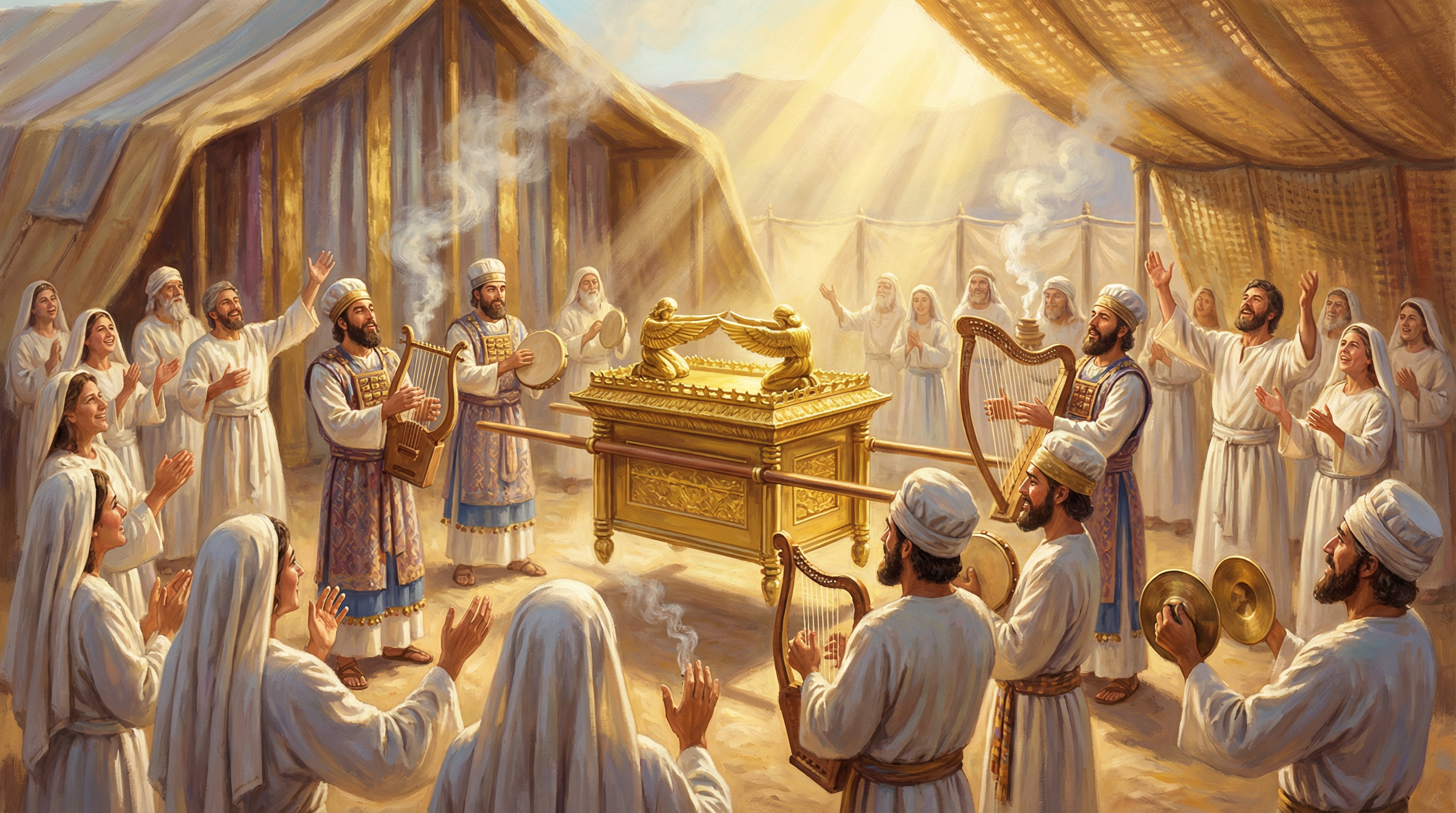
The second procession bringing the Ark to Jerusalem was marked by careful obedience, joyful celebration, and sacrificial worship. The Levites carried the Ark on their shoulders with poles, as God had commanded. After they had gone six steps, David sacrificed a bull and a fattened calf (2 Samuel 6:13), acknowledging God's blessing and expressing gratitude for His presence. The entire procession was accompanied by music, singing, and celebration.
David himself participated fully in the worship, wearing a linen ephod like the priests and dancing before the Lord with all his might (2 Samuel 6:14). This uninhibited worship from the king himself set the tone for the entire nation. David was not concerned with maintaining royal dignity or appearing sophisticated; he was consumed with joy at God's presence and expressed that joy through exuberant worship.
The contrast with Saul is striking. Saul had neglected the Ark throughout his reign, showing little concern for God's presence among His people. David, by contrast, made bringing the Ark to Jerusalem one of his highest priorities. This difference in their attitudes toward God's presence reflects the fundamental difference in their hearts—Saul was concerned primarily with his own position and power, while David was concerned with God's glory and presence.
Organizing the Levites for Worship
Once the Ark was established in Jerusalem, David did not simply leave worship to develop organically. Instead, he organized comprehensive systems for continuous worship and service before the Lord. First Chronicles 23-26 provides detailed accounts of how David organized the Levites, priests, musicians, gatekeepers, and treasurers for service in the house of the Lord.
David divided the Levites into divisions for various responsibilities. Some were appointed to carry the ark and minister before it. Others were designated as gatekeepers to guard the entrances to the sanctuary. Still others were assigned to care for the treasuries and the dedicated things. This organization ensured that worship would continue in an orderly, sustainable manner, with clear responsibilities and regular rotation of duties.
The total number of Levites from thirty years old and up was thirty-eight thousand (1 Chronicles 23:3). Of these, twenty-four thousand were to be in charge of the work of the temple, six thousand were to be officials and judges, four thousand were to be gatekeepers, and four thousand were to praise the Lord with musical instruments that David had provided for that purpose (1 Chronicles 23:4-5).
This massive investment of human resources in worship demonstrates David's priorities. In a time when every able-bodied man might have been needed for agriculture, construction, or military service, David dedicated thousands of men to full-time ministry in worship and service to God. He understood that a nation's relationship with God is its most important asset and that worship is not a luxury but a necessity.
The organization of the Levites also reflects David's administrative wisdom. By creating clear divisions, establishing regular rotations, and assigning specific responsibilities, David ensured that worship would continue consistently regardless of individual circumstances. This structure would endure for centuries, providing stability and continuity in Israel's spiritual life.
The Ministry of Music
Perhaps David's most distinctive contribution to worship was his emphasis on music and song. David himself was a skilled musician who had soothed Saul's troubled spirit with his harp playing. As king, he made music central to Israel's worship, appointing skilled musicians, composing psalms, and establishing patterns of musical worship that would influence God's people for millennia.
First Chronicles 25 describes in detail how David organized the musicians for temple worship. He appointed Asaph, Heman, and Jeduthun, along with their sons and relatives, to prophesy with harps, lyres, and cymbals. The total number of musicians trained and skilled in music for the Lord was 288, organized into twenty-four divisions corresponding to the divisions of the priests (1 Chronicles 25:7-8).
The text emphasizes that these musicians were not merely entertainers but ministers who prophesied through their music. First Chronicles 25:1 states that they were "to prophesy with lyres, harps and cymbals." Their music was not simply aesthetic or emotional but prophetic—it declared truth about God, proclaimed His deeds, and called people to respond to Him. This understanding of music as a vehicle for divine truth elevates worship music beyond mere performance to genuine ministry.
David provided the instruments for the musicians from his own resources. First Chronicles 23:5 mentions "the musical instruments I have provided for that purpose." This personal investment demonstrates David's commitment to excellence in worship. He did not expect the musicians to provide their own instruments or to make do with inferior tools. Instead, he ensured that they had quality instruments suitable for worshiping the King of kings.
The organization of the musicians into divisions meant that worship could continue around the clock. Different groups would serve at different times, ensuring that praise and music before the Lord never ceased. This concept of continuous worship reflects David's understanding that God is worthy of unending praise and that worship should not be limited to special occasions or festivals but should be the constant occupation of God's people.
David himself composed many of the psalms used in temple worship. The book of Psalms contains seventy-three psalms attributed to David, covering the full range of human experience and emotion—joy and sorrow, confidence and fear, praise and lament, thanksgiving and petition. These psalms provided Israel with a vocabulary for worship, teaching them how to express their faith, bring their struggles to God, and respond to His character and deeds.
The psalms also served a didactic purpose, teaching theology through song. They proclaimed God's character—His holiness, His love, His justice, His faithfulness. They recounted His mighty deeds in creation and redemption. They called people to trust in Him, obey His commands, and find their hope in His promises. Through the psalms, generations of Israelites learned who God is and how to relate to Him.
The Tent and the Ark
David prepared a special tent in Jerusalem to house the Ark of the Covenant. This was not the original tabernacle that Moses had constructed, which remained at Gibeon with the bronze altar and other furnishings. Rather, David erected a new tent specifically for the Ark in the City of David (2 Samuel 6:17; 1 Chronicles 16:1).
This arrangement, with the Ark in Jerusalem and the tabernacle at Gibeon, was unusual and temporary. It reflected the transitional nature of David's reign—the old order of the tabernacle was passing away, and the new order of the temple was not yet established. David's tent in Jerusalem anticipated the temple that Solomon would build, serving as a temporary dwelling place for God's presence until the permanent structure could be completed.
Inside this tent, David established continuous worship before the Ark. He appointed Levites to minister before the Ark regularly, to make petition, to give thanks, and to praise the Lord (1 Chronicles 16:4). This was a significant innovation. Previously, the Ark had been hidden behind the veil in the Most Holy Place, accessible only to the high priest once a year on the Day of Atonement. Now, under David's arrangement, Levites ministered before the Ark continuously, offering praise and worship in God's presence.
This greater access to God's presence foreshadowed the New Covenant reality that believers enjoy through Jesus Christ. Just as David's tent allowed the Levites to minister before the Ark in a way that had not been possible under the Mosaic system, so Christ's death tore the veil in the temple and opened the way for all believers to enter God's presence with confidence (Hebrews 10:19-22). The worship that David established in his tent anticipated the worship that would characterize the church—continuous, joyful, accessible to all who belong to God's people.
A Psalm of Thanksgiving
When the Ark was first brought into David's tent, David composed a psalm of thanksgiving that was sung by Asaph and his associates. This psalm, recorded in 1 Chronicles 16:8-36, combines portions of what would later appear as Psalms 105, 96, and 106. It serves as a model for corporate worship and reveals the themes that David considered essential in praising God.
The psalm begins with a call to worship: "Give praise to the Lord, proclaim his name; make known among the nations what he has done. Sing to him, sing praise to him; tell of all his wonderful acts" (1 Chronicles 16:8-9). This opening establishes worship as both vertical (directed to God) and horizontal (proclaimed to the nations). Worship is not merely a private, internal experience but a public declaration of God's character and deeds.
The psalm continues by calling God's people to remember His covenant and His mighty works: "Remember the wonders he has done, his miracles, and the judgments he pronounced" (1 Chronicles 16:12). This emphasis on remembering is central to biblical worship. We worship not based on our current feelings or circumstances but based on the objective reality of who God is and what He has done. Recalling God's past faithfulness strengthens our faith and gives us confidence for the future.
The psalm also emphasizes God's universal reign and His worthiness to be praised by all creation: "Sing to the Lord, all the earth; proclaim his salvation day after day. Declare his glory among the nations, his marvelous deeds among all peoples. For great is the Lord and most worthy of praise; he is to be feared above all gods" (1 Chronicles 16:23-25). This missionary dimension of worship—declaring God's glory among the nations—reflects God's ultimate purpose to be glorified by people from every tribe, tongue, and nation.
The psalm concludes with a prayer for God's continued blessing and a doxology: "Cry out, 'Save us, God our Savior; gather us and deliver us from the nations, that we may give thanks to your holy name, and glory in your praise.' Praise be to the Lord, the God of Israel, from everlasting to everlasting" (1 Chronicles 16:35-36). The people responded to this doxology with "Amen" and "Praise the Lord," demonstrating their agreement and participation in the worship.
This psalm established patterns that would characterize Israel's worship for centuries. It combined praise and petition, thanksgiving and intercession, remembrance of the past and hope for the future. It engaged both the mind (recalling God's deeds and character) and the emotions (expressing joy, gratitude, and awe). It was both individual and corporate, calling each person to worship while uniting the community in common praise.
Preparation for the Temple
Although God did not allow David to build the temple himself, David devoted enormous energy and resources to preparing for its construction. He gathered materials, organized the workforce, designed the layout, and made financial provision so that Solomon would have everything needed to complete the project.
First Chronicles 22 describes David's preparations. He provided large quantities of iron for nails and fittings, more bronze than could be weighed, and cedar logs without number from Sidon and Tyre (1 Chronicles 22:3-4). He also set aside vast amounts of gold and silver for the temple construction. When David presented his plans to the assembly of Israel, he reported that he had provided "a hundred thousand talents of gold, a million talents of silver, quantities of bronze and iron too great to be weighed, and wood and stone" (1 Chronicles 22:14).
These quantities are staggering. A talent was approximately 75 pounds, so a hundred thousand talents of gold would be about 3,750 tons. Whether these numbers are literal or represent conventional expressions for enormous quantities, they demonstrate David's extraordinary commitment to providing for the temple. He gave sacrificially and generously, holding nothing back in his desire to see God's house built with excellence and beauty.
David also designed the temple's layout and furnishings under divine inspiration. First Chronicles 28:11-12 records that David gave Solomon "the plans for the portico of the temple, its buildings, its storerooms, its upper parts, its inner rooms and the place of atonement. He gave him the plans of all that the Spirit had put in his mind for the courts of the temple of the Lord and all the surrounding rooms, for the treasuries of the temple of God and for the treasuries for the dedicated things."
This divine revelation of the temple's design parallels God's revelation to Moses of the tabernacle's design. Just as Moses received the pattern for the tabernacle on Mount Sinai, so David received the pattern for the temple through the Spirit. This ensures that the temple would reflect God's purposes and preferences, not merely human architectural preferences.
David also organized the divisions of priests and Levites who would serve in the temple, established the courses of musicians and gatekeepers, and appointed officials to oversee the temple's administration. All of this preparation meant that when Solomon began construction, he had clear plans, abundant materials, organized personnel, and established patterns of worship to implement.
Lessons for Today
David's establishment of worship in Jerusalem offers rich lessons for believers and churches today. Several key principles emerge from this narrative that have direct application to our worship and our spiritual lives.
First, we learn that worship should be central to our lives and to the life of the church. David made worship a priority, investing enormous resources and energy in establishing patterns of praise and service to God. Similarly, we should make worship—both corporate and personal—central to our lives, not a peripheral activity squeezed in when convenient.
Second, we see that worship requires both passion and order. David worshiped with exuberant joy, dancing before the Lord with all his might. Yet he also organized worship carefully, establishing divisions, assigning responsibilities, and creating sustainable structures. True worship engages our emotions while also engaging our minds and our wills in ordered, thoughtful response to God.
Third, we recognize that music is a powerful vehicle for worship and for teaching truth. David understood that music could express what words alone cannot convey and could implant truth deeply in the heart. Churches today should value music in worship, investing in training musicians, composing songs that are both theologically rich and emotionally engaging, and using music to declare God's glory and teach His truth.
Fourth, we learn that worship should be continuous, not limited to special occasions. David established around-the-clock worship before the Ark, with different divisions of musicians and Levites serving at different times. While we may not maintain literal 24/7 worship services, we are called to lives of continuous worship, offering ourselves as living sacrifices and doing everything for God's glory (Romans 12:1; 1 Corinthians 10:31).
Fifth, we see that preparation for worship matters. David studied God's word to learn the proper way to bring the Ark to Jerusalem. He consecrated himself and the Levites before approaching God's presence. He prepared carefully for worship, recognizing that approaching the holy God requires reverence and obedience. We too should prepare our hearts for worship, confessing sin, meditating on God's word, and approaching Him with reverence and awe.
The Heart of a Worshiper
What made David "a man after God's own heart" was not his perfection—he would later commit grievous sins—but his passion for God's presence and his commitment to worship. David understood that knowing God and enjoying His presence is life's highest privilege and greatest treasure. He organized his kingdom around worship because he understood that worship is the proper response to who God is and what He has done.
David's psalms reveal a heart that was fully engaged with God—praising Him in joy, crying out to Him in distress, confessing sin with genuine repentance, trusting Him in uncertainty, and finding hope in His promises. This authentic, wholehearted engagement with God is the essence of worship and the mark of a true worshiper.
As believers in Jesus Christ, we have even greater reason and greater access for worship than David enjoyed. The veil has been torn, the way into God's presence has been opened through Christ's blood, and the Holy Spirit dwells within us. We can approach God's throne with confidence, knowing that we are accepted in Christ and welcomed as beloved children. Our worship should reflect this privilege, combining reverent awe at God's holiness with confident joy in His grace.
Conclusion
David's establishment of worship in Jerusalem transformed Israel's spiritual life and created patterns of worship that would endure for centuries. His passion for God's presence, his commitment to organizing worship according to God's revealed will, his emphasis on music and song, and his generous provision for the temple all demonstrate a heart captivated by God's glory and devoted to His honor.
The worship that David established in Jerusalem points forward to the worship that characterizes the church and that will fill eternity. In the new creation, the redeemed from every nation will gather around God's throne, offering continuous praise to the Lamb who was slain. The songs that David composed will join with the new song of redemption in an eternal symphony of worship that never ends.
As we reflect on David's legacy of worship, we are challenged to examine our own hearts. Do we share David's passion for God's presence? Do we prioritize worship in our lives and in our churches? Do we approach God with both reverence and joy? Do we invest in worship, recognizing it as life's highest calling and greatest privilege? May we, like David, be people after God's own heart—wholehearted worshipers who find our greatest joy in knowing and glorifying the God who has redeemed us and called us to Himself.