
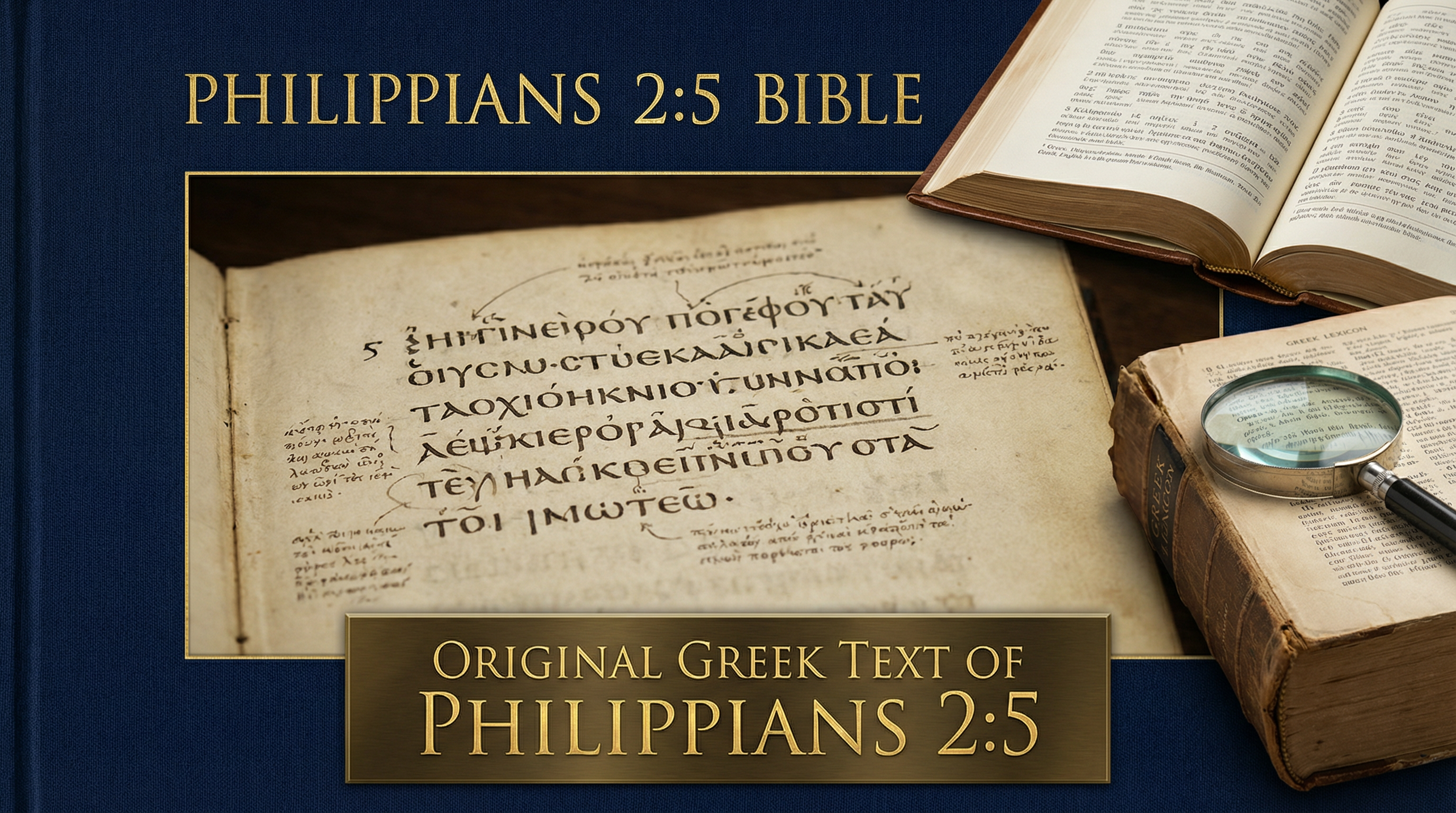
Original Greek Text of Philippians 2:5
Detailed analysis of the Greek text of Philippians 2:5, including textual variants and word-by-word morphological analysis.
Original Greek Text of Philippians 2:5
Greek Text Variants
The following are the major Greek text traditions of Philippians 2:5, showing minor variations that do not significantly alter the core meaning:
Nestle 1904
τοῦτο φρονεῖτε ἐν ὑμῖν ὃ καὶ ἐν Χριστῷ Ἰησοῦ,
τοῦτο φρονεῖτε ἐν ὑμῖν ὃ καὶ ἐν Χριστῷ Ἰησοῦ,
Westcott and Hort 1881
τοῦτο φρονεῖτε ἐν ὑμῖν ὃ καὶ ἐν Χριστῷ Ἰησοῦ,
τοῦτο φρονεῖτε ἐν ὑμῖν ὃ καὶ ἐν Χριστῷ Ἰησοῦ,
Byzantine Majority Text 2005
Tοῦτο γὰρ φρονείσθω ἐν ὑμῖν ὃ καὶ ἐν χριστῷ Ἰησοῦ·
Tοῦτο γὰρ φρονείσθω ἐν ὑμῖν ὃ καὶ ἐν χριστῷ Ἰησοῦ·
Greek Orthodox Church
τοῦτο φρονείσθω ἐν ὑμῖν ὃ καὶ ἐν Χριστῷ Ἰησοῦ,
τοῦτο φρονείσθω ἐν ὑμῖν ὃ καὶ ἐν Χριστῷ Ἰησοῦ,
Textus Receptus 1894 (Scrivener)
τοῦτο γὰρ φρονείσθω ἐν ὑμῖν ὃ καὶ ἐν Χριστῷ Ἰησοῦ·
τοῦτο γὰρ φρονείσθω ἐν ὑμῖν ὃ καὶ ἐν Χριστῷ Ἰησοῦ·
Word-by-Word Morphological Analysis
| Greek Word | Transliteration | English Translation | Morphology |
|---|---|---|---|
| Τοῦτο | touto | This | Demonstrative Pronoun, Accusative Neuter Singular |
| φρονεῖτε | phroneite | let mind be | Verb, Present Imperative Active, 2nd Person Plural |
| ἐν | en | in | Preposition |
| ὑμῖν | hymin | you | Personal Pronoun, Dative 2nd Person Plural |
| ὃ | ho | which | Relative Pronoun, Nominative Neuter Singular |
| καὶ | kai | also | Conjunction |
| ἐν | en | in | Preposition |
| Χριστῷ | Christō | Christ | Noun, Dative Masculine Singular |
| Ἰησοῦ | Iēsou | Jesus | Noun, Dative Masculine Singular |
Notable Textual Variations
Variation 1: The Presence of γὰρ (gar, "for")
Some manuscripts (Byzantine Majority Text and Textus Receptus) include γὰρ (gar, "for") after τοῦτο (touto, "this"), which adds an explanatory element to the sentence. This would render the verse as:
"For let this mind be in you..."
This addition provides a stronger logical connection to the preceding verses, emphasizing that what follows is the reason or explanation for Paul's previous exhortation.
Variation 2: φρονείσθω vs. φρονεῖτε
Some manuscripts use φρονείσθω (phroneisthō, "let this mind be") instead of φρονεῖτε (phroneite, "let mind be"). Both are imperative forms, but they differ slightly:
- φρονεῖτε (phroneite) - Active voice, 2nd person plural: "you all, think/mind this"
- φρονείσθω (phroneisthō) - Passive/middle voice, 3rd person singular: "let this be minded"
The first emphasizes the believers' active responsibility to adopt this mindset, while the second presents it more as something that should be allowed to happen or be cultivated.
Theological Significance of the Variations
Despite these textual variations, the core meaning remains consistent across all manuscript traditions. The verse calls believers to adopt the same mindset or attitude that characterized Christ Jesus, setting up the profound Christological passage that follows (verses 6-11).
The variations demonstrate:
- Textual Stability - The essential message is preserved across different manuscript families
- Minor Stylistic Differences - Changes reflect scribal preferences rather than theological disputes
- Interpretive Flexibility - Both active and passive constructions support the same theological point
The Meaning of φρονέω (phroneō)
The central verb φρονέω (phroneō) is particularly rich in meaning. It encompasses more than mere intellectual thinking; it includes:
- Mindset - A settled way of thinking
- Attitude - An orientation of heart and will
- Disposition - A fundamental character orientation
- Way of thinking - A pattern of thought that leads to action
Paul is not simply asking believers to think about Christ, but to think with the mind of Christ—to adopt His perspective, values, and priorities as their own.
Connection to the Christ Hymn
This verse serves as the introduction to what scholars call the "Christ Hymn" (Philippians 2:6-11), one of the earliest and most profound Christological passages in the New Testament. The Greek text of verse 5 creates a seamless transition into this hymn, with the relative pronoun ὃ (ho, "which") pointing forward to the description of Christ's self-emptying and exaltation that follows.
This textual analysis provides the foundation for understanding how the Early Church Fathers, Medieval theologians, and Reformation writers interpreted this profound verse.